





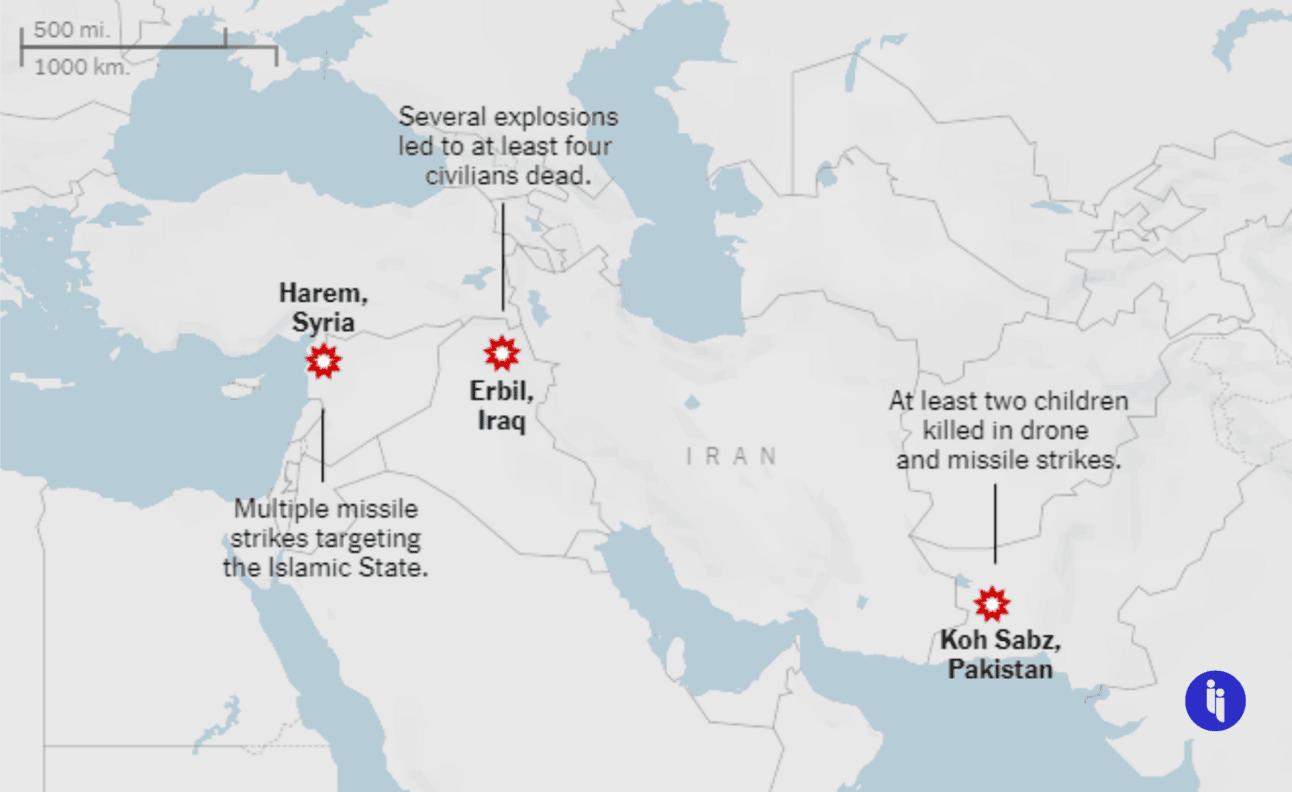
Iran has hit targets in three neighbouring countries this week.
First on Monday, it claimed a hit on an Israeli intelligence site in Erbil (the capital of Iraqi Kurdistan) in retaliation for recent Israeli strikes on Iranian interests.
There’ve been reports of Israeli intelligence operations in the area, though local leaders rejected Iran’s claims, and the casualties were a Kurdish real estate tycoon and his family.
Stay on top of your world from inside your inbox.
Subscribe for free today and receive way much more insights.
Trusted by 151,000+ subscribers
No spam. No noise. Unsubscribe any time.
This wasn’t Iran’s first attack on Iraqi Kurdistan. Heck, it wasn’t even Iran’s first attack on a tycoon’s villa in Iraqi Kurdistan.
Second, and hours later, Iran says it hit ISIS targets in Syria’s last opposition stronghold (Idlib) in retaliation for suicide bombings that killed 94 Iranians (who were marking the US assassination of an Iranian general in 2020).
Again, this wasn’t Iran’s first attack on ISIS targets in Syria.
Then finally on Tuesday, Iran used rockets and drones to hit two Jaish al-Adl strongholds over the border in Pakistan, reportedly killing two children.
In a rare instance of common ground, both the US and Iran consider Jaish al-Adl, or the ‘Army of Justice’, a terrorist group. It’s a Sunni ethnic Baluch militia that operates along the Iran-Pakistan border, seeking an independent Baluchistan.
And again, this wasn’t the first time Iran has gone after Jaish targets in Pakistan, but it’s Iran’s first such strike with missiles, and its deepest push into Pakistani turf yet.
So what’s Iran up to?
Iran’s foreign minister made a controversial appearance at Davos yesterday (Wednesday), arguing Iran has good relations with its neighbours and was just eliminating common enemies. But Iran likely had other objectives, including to:
- show strength domestically after several recent security failures
- show strength regionally after Israel hit an Iranian general in Syria, and
- do it all in a way that avoids blowback (eg, targeting “common enemies“).
Syria hasn’t commented yet, and Iraq realistically can’t do much beyond lodging diplomatic protests. So that leaves nuclear-armed Pakistan.
And Pakistan was left with a choice between a) looking weak, or b) retaliating and risking a broader conflict. With Pakistan’s powerful military establishment clearly embarrassed, it opted for option b overnight, launching reciprocal strikes on Baluch targets in Iran.
Iran seems to be getting some blowback after all.
INTRIGUE’S TAKE
Attack one neighbour on Monday, hit another two on Tuesday, then chill at Davos on Wednesday. It’s like a weird cover of that Craig David song.
There are clearly local drivers at play: the Baluchs resent Iranian and Pakistani rule; ISIS hates Shiite-majority Iran; the Houthis want to consolidate their hold on power in Yemen; and Iran wants to expand its regional sway.
But zooming out, it’s so connected regionally – the US and others see Iran as the common thread, while Iran and its proxies say it’s all the US and Israel.
And zooming out further, it’s connected globally. Russia is invading Ukraine with the help of both Iran (the two are about to sign a treaty) and North Korea (which just ramped up tensions with its own neighbour).
These days, everything’s connected.
Also worth noting:
- The Saudi foreign minister told Davos, “we agree that regional peace includes peace for Israel, but that can only happen through peace for Palestinians through a Palestinian state.”
- The US, which just re-designated the Houthis as terrorists, says it hit 14 Houthi pre-launch ballistic missiles overnight, while the Houthis hit a US civilian ship in the Gulf of Aden.