





US President Joe Biden and Israeli Prime Minister Benjamin Netanyahu spoke yesterday for the first time since an Israeli airstrike killed seven aid workers on Monday.
It was a tense phone call. The bare-bones White House readout was dripping with unspoken tension, with Biden branding Monday’s strike and the humanitarian situation in Gaza as “unacceptable” while reiterating that “an immediate ceasefire is essential”.
Biden seemed to warn Netanyahu that this was Israel’s last chance, saying, “U.S. policy with respect to Gaza will be determined by our assessment of Israel’s immediate action on these steps.”
Stay on top of your world from inside your inbox.
Subscribe for free today and receive way much more insights.
Trusted by 161,000+ subscribers
No spam. No noise. Unsubscribe any time.
Here’s what we know about Monday’s attack:
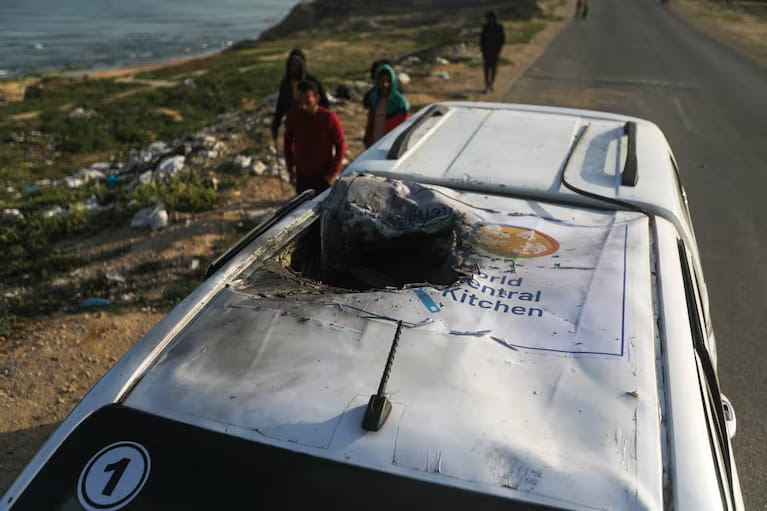
- The Israeli military (IDF) struck an aid convoy from World Central Kitchen (WCK), a US-based NGO founded by celebrity chef José Andrés that provides food relief. The convoy had been dropping off aid at a warehouse in central Gaza.
- All seven aid workers (three UK citizens, one Australian, one Palestinian, one Polish, and one dual US-Canadian citizen) were killed.
- The aid convoy of two armoured cars and one ‘soft-skin’ vehicle appear to have been targeted in three separate strikes. Two experts questioned by the BBC believe the IDF used drone-launched weapons.
- An official statement on the WCK website said the convoy had alerted the IDF about its mission, was travelling in a deconflicted zone, and had branded its vehicles with the WCK logo.
So, how could this have happened?
José Andrés described the incident as a “direct attack” on aid workers and accused Israel of targeting the aid convoy “systematically, car by car.” “This looks like it’s not a war against terrorism anymore. It seems this is a war against humanity itself,” Andrés said.
The IDF quickly issued an apology, calling the strike a “grave mistake” caused by “misidentification”, and was “not carried out with the intention of harming WCK aid workers”. A Haaretz report said the strike was launched because a Hamas member was incorrectly suspected to be travelling within the aid convoy.
The former head of MI6, Sir Alex Younger, said the attack was “systematic of an approach to targeting that has on occasion bordered on the reckless.” “It is hard not to conclude that insufficient care is being paid to the collateral risk of these operations”, he added.
What’s happened since?
- Shortly after yesterday’s Biden-Netanyahu call, Israel said it would allow more aid crossings into Gaza. It’s unknown whether that’s as a result of Biden’s pressure or because Israel’s highest court sharply questioned why the government wasn’t allowing more aid into Gaza.
- Several aid agencies, including WCK, have suspended their operations in Gaza, which will worsen what a UN-backed body has already classified as an impending famine.
- The US, Canada, Australia, the UK and others have called for a full investigation into the strike.
- Benny Gantz – Netanyahu’s main political rival – called for early elections in September to “renew trust” in the government. Netanyahu’s Likud party called the move “petty politics”.
Meanwhile, a Hamas official told Reuters yesterday that ceasefire talks have made no progress. Pentagon spokesperson John Kirby said he didn’t expect the strikes on Monday to impact negotiations.
INTRIGUE’S TAKE
“This looks like it’s not a war against terrorism anymore. It seems this is a war against humanity itself.”
You can agree or disagree with Chef, but it’s clear that Israel has lost control of the narrative around its military response to the October 7 Hamas attacks. The question is, does that matter?
For Netanyahu, as long as the US continues to support Israel, then the answer is probably not. And while Biden personally can’t stand Netanyahu, it’s not clear how he can use his leverage over Netanyahu while maintaining US support for Israel.
One potential option is to channel former president George Bush Snr, who in 1991 refused to give Israel $10B in aid funding unless it stopped expanding settlements on Palestinian land. Bush’s ultimatum outraged Israeli leaders at the time (a minister allegedly called Bush an antisemite), but it worked – a more moderate Israeli government was elected and acceded to US demands.
You can bet Biden’s advisers have discussed (and perhaps fantasised about) pulling a similar move, but the situations are very different: Israel hadn’t been attacked and wasn’t at war in 1991, and the US wasn’t in an election year. For those reasons and more, we think it’s unlikely much will change in the near term.
In the longer term, only historians will be able to fully account for the damage that Israel’s military actions in Gaza are causing to its international reputation, and whether that even matters.
Also worth noting:
- At least 196 humanitarian workers have died since the start of the Israel-Hamas conflict, according to the UN.
- Israel is using AI systems collectively known as ‘Lavender’ to identify over 37,000 military targets, according to a joint investigation by +972 Magazine and Local Call.