




Headlines have gravitated towards the Arctic and Davos this week, but a couple of world leaders ended up skipping out on the World Economic Forum, including Syria’s al-Sharaa.
Sharaa’s excuse? Oh, just ISIS jailbreaks, domestic infighting, and a shaky ceasefire. So let’s dive in?
Since the jihadist-turned-statesman toppled Syrian dictator Assad in December 2024, al-Sharaa has struggled to unify Syria’s minority factions and consolidate power.
Stay on top of your world from inside your inbox.
Subscribe for free today and receive way much more insights.
Trusted by 160,000+ subscribers
No spam. No noise. Unsubscribe any time.
The biggest question was around the US-backed, Kurdish-led Syrian Democratic Forces (SDF), controlling a third of Syria since emerging in 2015 to fight ISIS. The SDF was wary of Kurds getting screwed (again), this time under Sharaa’s Islamist-led administration.
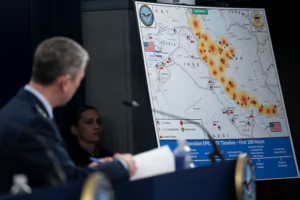
But their uneasy status quo just collapsed. There’s debate over who fired the first shot (it might’ve been an SDF drone), but fighting broke out in Syria’s second-largest city of Aleppo earlier this month, with government forces seizing two SDF strongholds before expanding rapidly eastward across broader SDF turf until Sunday’s ceasefire.
Critically, as SDF lines collapsed, there was a jailbreak at one of the SDF-run prisons holding ISIS members, with at least 120 escaping (Damascus claims it’s re-arrested 81).
Technically that four-day ceasefire is now expiring, but the two sides seem to have agreed a 14-point peace plan for what’s next, including the SDF…
- a) surrendering most of its governing authorities to Damascus
- b) integrating into the Syrian military, but also
- c) leaving local security forces to secure Kurdish-majority areas in the north-east.
Yet two big underlying tensions persist.
First, resources. The Kurdish northeast holds most of Syria’s oil and gas, which al-Sharaa needs for reconstruction elsewhere, plus his administration’s own broader legitimacy.
Second, visions. While the al-Sharaa administration wants to centralise state control, the SDF’s Kurds want more cultural recognition and political autonomy. Al-Sharaa threw an olive branch in the form of a decree recognising Kurdish language and citizenship (of Syria), but Turkey made similar promises in the early 2010s before another crackdown.
So for the SDF, this ceasefire looks much more like a capitulation.
And where is the US in all of this?
The SDF’s American backers have endorsed the capitulationceasefire, and the US envoy (Barrack) says any rationale for the US-SDF partnership has now “largely expired” anyway. The SDF also argued it needed help holding all those ISIS prisoners, but the Pentagon just yoinked that too, transferring 7,000 ISIS detainees to Iraqi-controlled facilities.
So while US officials are backing this outcome as a win for a “unified Syria”, this outcome also conveniently helps with Trump’s plan to finally get US troops out of Syria.
The other winner is of course Turkey’s Erdogan, who has long called for the SDF (along Turkey’s border) to disarm and disband. So for al-Sharaa’s main backer, it’s all smiles.
Still, this is far from a done deal. Both Damascus and the SDF have already claimed ceasefire violations, including nearly a dozen deaths and many more wounded.
Intrigue’s Take
Any disappointment at al-Sharaa’s Davos absence was probably just the missed poetry of a jihadist officially completing his apotheosis to legitimate statesman by appearing on a Davos panel and maybe even rocking a puffer jacket.
But while al-Sharaa has made remarkable progress abroad (whether getting the Saudis and Qataris to pay off Syria’s debt, or getting the State webmaster to scrub the US bounty on his head), he’s continued to struggle on the home front as Druze, Alawites, Kurds and other minority factions fret about his true intentions.
Meanwhile, Israel has been awfully quiet, though it’ll be alarmed at its US allies seemingly now aligning with regional foes Turkey. The Kurds (like the Druze and others) have also played a role in Israel’s long-running periphery doctrine (to back other regional minorities partly as a way to dilute and distract powers). Some argue Israel benefits long-term from a stable, unified Syrian neighbour, but that really depends on who’s at the helm in Damascus — and for all his wins, the world is still getting to know Ahmed Al-Sharaa.