




🌍 Will Iran collapse?
Plus: Why Ireland recalled passports

|
Today’s briefing: |
|
Good morning Intriguer. While the outcome feels unknowable at the time, history eventually settles on a defining image for each moment, whether it’s the Tiananmen tank man, the original Prague tank man, or Vietnam’s napalm girl.
These days, the blackout imposed by Iran’s ruling clerics limits our view — and maybe broader media coverage — of the mass protests still unfolding across the country, but surely an early image contender will be the women of Iran (including many abroad) lighting cigarettes with burning images of the supreme leader.
Anyway, let’s examine the big question: will Iran’s regime collapse?

PS – A heads-up that Wednesday will be our last edition this week as we duck off for a quick team retreat in Charleston, but we’ll be back in your inbox Monday!
Quote of the day
“This is about whether the Fed will be able to continue to set interest rates based on evidence and economic conditions—or whether instead monetary policy will be directed by political pressure or intimidation.”
That’s what US Fed chair Jerome Powell just said, after the justice department threatened criminal indictment over evidence he gave around a Fed renovation project. The USD fell amid questions around the Fed's independence.
Time’s up bro

The ayatollah (L), and the exiled crown prince (Pahlavi) calling for his removal.
☝️ That's the question on everyone's lips, and one possible answer actually emerged during Iran's last collapse in 1979: a theory of revolutions from Harvard's Theda Skocpol.
Skocpol later reflected on where her theory (more agrarian-peasant focused) went wide, but it still offers a useful guide, so let's break it down and adapt it a little, shall we?
Skocpol broadly argues that for any regime to collapse, you first need…
-
A breakdown in state capacity
We've charted this over the years, but Iran's mullahs now face a perfect storm, including a) crippling droughts (dams are at <10%), b) a 99% collapse in the rial since 2018 (20% in the last month), and c) a security apparatus weakened not just abroad (Hezbollah, Hamas, and the Houthis) but at home via last year’s US and Israeli hits.
So to be clear, the state is still functioning — energy and transport workers are still turning up, for example. But it's under massive pressure and flailing for a response, trying $7 monthly subsidies one day, then street massacres the next. And that brings us to…
-
Elite fracture
A collapse usually involves internal splits as mullahs and generals argue over next steps behind the ageing ayatollah's defiant rhetoric. But while there've been rumours of elite families skipping town and even generals defecting, some of this looks like informational warfare aimed at encouraging (rather than reporting on) developments.
And sure, we can guess which rivals might emerge — we’d guess a ‘soft coup’ via an IRGC-backed hardliner like parliamentary speaker Ghalibaf, rather than an outsider like the pragmatic ex-president Rouhani, let alone a regime enemy like Rajavi (head of the 'People's Mujahadin') or Pahlavi (the US-based crown prince in exile).
But that all really depends on any…
-
Splits in the security apparatus
For now, the evidence still points to regime forces executing orders, leaving thousands detained, disappeared, or dead. But keep an eye on any credible reports of desertion, 'standing aside', or friction — both within the IRGC, but also between the IRGC (which answers direct to the ayatollah) and Iran's weaker and more conventional military (Artesh).
The regime has long under-equipped the less-ideological Artesh, precisely to avoid coups. And you could read the Artesh role here either way: we were surprised by its Saturday pledge merely to "protect public property" — a subtle distancing from the IRGC protecting the regime? But the statement also aligned with regime defence in other ways, like framing the protests as US-Israeli plots, and reaffirming loyalty to the ayatollah.
Then to casually riff on a Harvard theory (Skocpol sticks more to structure), there's also…
-
Ideological exhaustion
Lots of folks (even Max Weber) have examined this over the years, but the basic idea is if a regime's own justificatory story (messianic Shiite theocracy) stops working, authority becomes more likely to shift to a rival narrative that does work, perhaps like the pan-Persian nationalism encouraged by Pahlavi and even Israel. When the story switches, bureaucrats become more likely to disobey, and generals more likely to defect.
But again, the picture is mixed: while there are now millions in the streets, and the regime's own true believers seem outnumbered by opportunists, it's worth recalling 13 million folks still voted for the most regime-aligned candidate in 2024.
And while the world has changed, maybe this again nudges us back to that 'soft coup': enough to quell the unrest, and update — but not erase — the regime's founding story. That’d be a similar outcome to Venezuela, which might appeal to Trump if not the people.
But so much also still depends on the millions in the streets, which brings us to…
-
Cascade dynamics
Duke University’s Timur Kuran is one of the gurus here, explaining why regimes can look stable until they're not: folks naturally hide their opposition until it becomes safe to get involved, triggering a participation cascade. That's arguably what we saw on Thursday after Prince Pahlavi's protest calls, though key players like oil workers shrugged him off.
So now it comes down to a grim and unpredictable calculation: whether the millions of desperate and angry folks on Iran's streets can outlast a regime now actively degrading their coordination via blackouts, while attacking their cascading confidence with violence.
For now, the result still looks like a coin-toss.
Intrigue’s Take
The other big calculation is how the Israelis and Americans end up getting involved. We say 'how' because it's beyond 'if' at this stage, given a) the ayatollah's long-running calls to end both the US and Israel, b) the US wanting out of the Middle East (easier with a benign Tehran), and c) both allies riding high after some surprising hits on foes.
President Trump just hinted a nuclear deal might now be back on the table, though that smells like a fake-out: either the regime is (again) dangling the prospects of a deal to ease US pressure, or this is a repeat of last year when Trump offered similar hints while secretly approving the biggest B2 bomber strikes in history. Our best guess is we’ll see targeted hits on IRGC bases and leadership, perhaps opening more space for the Artesh, though nobody in Iran wants to be seen as an appendage of Israeli or American power.
The other question is how this all ripples out beyond Iran's borders: its neighbours (like Turkey, Afghanistan, and Armenia) are already bracing for refugee flows, and their spooks will realistically be on the ground (particularly among Iran’s border minorities) in hopes of maximising each neighbour’s influence over whatever is next.
But more broadly, the main ripple is oil — the moment this slows or stops, it becomes a headache for Iran's one real buyer: China. We're talking up to a fifth of China's crude imports, plus the ~4% now wobbling out of Venezuela. Beijing has been building colossal strategic reserves for years while diversifying its sources, but this'll still hurt. And with Beijing simultaneously squeezing America’s access to rare earths, maybe that’s DC’s point.
Meanwhile, elsewhere…
 |
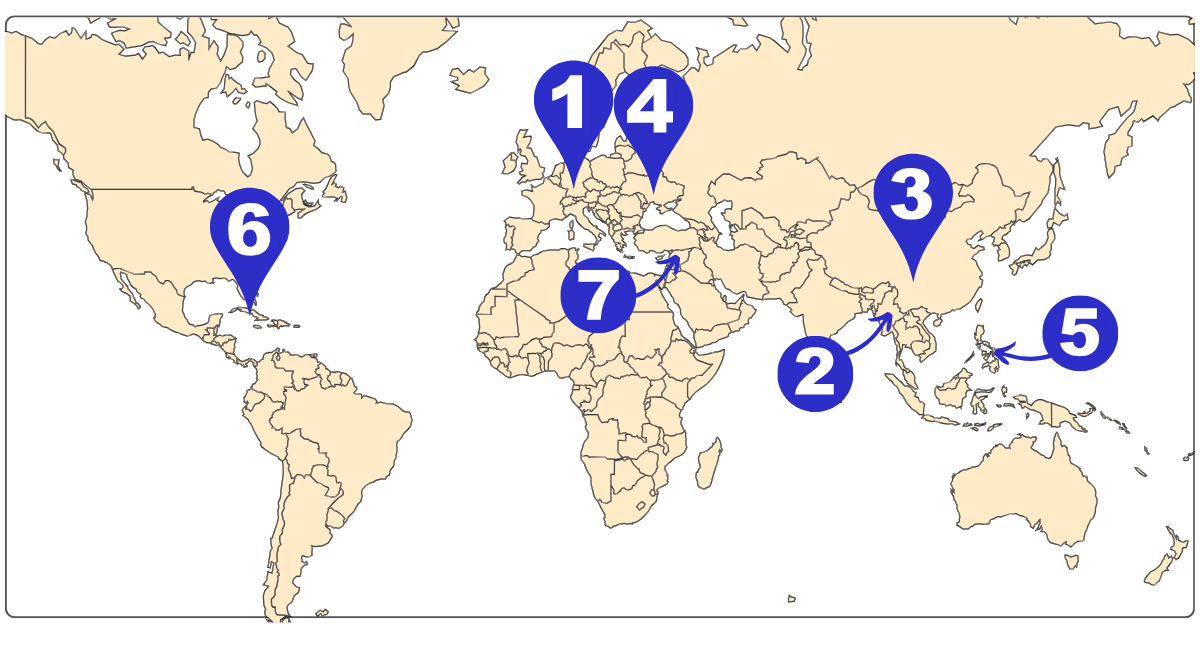
🇩🇪 GERMANY – Can’t touch this. Comment: Outlets are duly reporting this proposed NATO mission as something to comfort a Trump 2.0 worried about Arctic security, but it’s really about deterring him. |
 |
🇲🇲 MYANMAR – Sham elections. Comment: The ruling military junta hopes the vote will help consolidate its legitimacy at home and abroad, as it regains the battlefield initiative (with help from Beijing and Moscow) against Myanmar’s various ethnic militias. |
 |
🇨🇳 CHINA – Crossfit. Comment: Interestingly, India and Brazil appear to have opted out of the joint drills altogether. They’ll point to scheduling or other reasons, but this might be more about not poking Trump in the eye while talks continue to stabilise their US trade ties. |
 |
🇺🇦 UKRAINE – Power under fire. Comment: This looks like a classic Putin asymmetric response to Trump’s tanker seizure last week — can’t hit the US back, so hit Ukraine instead. Meanwhile, Putin’s use of the hypersonic Oreshnik missile against Ukraine’s western city of Lviv is an attempt to intimidate Ukraine’s European backers: ie, imagine what else we can hit. |
 |
🇵🇭 PHILIPPINES – Rubbish collapse. Comment: Waste disposal is a hot issue in the Philippines — long seen as an easy source of foreign exchange, some legislators now want foreign waste imports banned. |
 |
🇨🇺 CUBA – No oil, no deal. Comment: This effectively broadens the US embargo on Cuba, and ratchets up the (already high) pain beyond the regime. It’s a bet the island’s rulers will buckle now in a way they haven’t in seven decades. |
 |
🇸🇾 SYRIA – Infighting. |
Extra Intrigue
🤣 Your weekly roundup of the world’s lighter news
-
For the second year in a row, hundreds have gathered in Birmingham’s central square for a NYE fireworks display that turned out to be an online hoax.
-
A Dutch court has annulled a wedding certificate after it found the officiant’s ChatGPT-generated ceremony fell short of legal requirements.
-
Ireland has recalled 13,000 passports due to a misprint that omitted the ‘IRL’ country code.
-
A UK court has ruled that a microwave does not convert your hotel room into an apartment.
-
And Kenya’s tennis federation has apologised after it allowed a beginner to compete in a professional tennis competition (she lost after 20 double faults).
Gadget of the day

Credits: @DamienLicata via Twitter/X
What happens in Vegas stays in Vegas, unless it’s the famous Consumer Electronics Show, in which case whatever is showcased in Vegas eventually finds its way into your home.
Among this year’s weird and wonderful gadgets were…
-
Lollipop Star (above), a candy with bone conduction music technology for those who want Akon’s smooth afrobeats pumped right into their cranium mid-snack
-
A robot vacuum that can finally climb your stairs, and
-
Smart toilet sensors that can track your ehm… health.
Today’s poll
Do you think this unrest will topple Iran's regime? |
Yesterday’s poll: Do you think the US will end up with Greenland?
🌎 Yes, Trump has been clear (44%)
❌ No, the costs are too high (55%)
✍️ Other (write in!) (1%)
Your two cents:
-
❌ T.S: “The cons far outweigh the pros; alienating allies, spurning alliances, high cost, and of course the already existing agreement that allows the US to do all of the things the US claims it wants to do through annexation.”
-
🌎 C.O.E: “Trump doesn't seem to care whose toes he steps on, and Europe sees itself as too weak to stand up to Trump.”
-
✍️ B: “Trump likely needs European partners to persuade or pressure President Zelensky to accept a peace agreement. By proposing something deliberately unrealistic, such as the acquisition of Greenland, Trump may be attempting to force Europe’s hand.“