



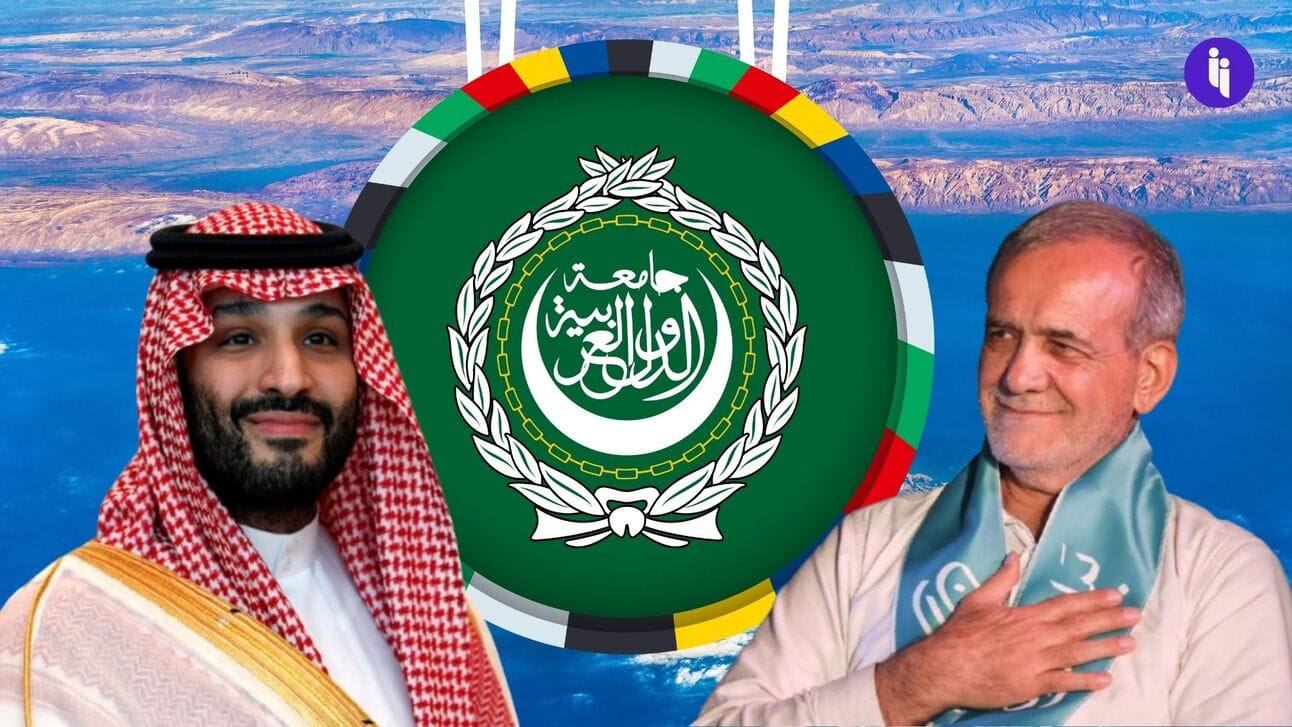
Saudi Arabia’s crown prince (‘MBS’) hosted a joint Arab League and Organisation of Islamic Cooperation summit in Riyadh yesterday (Monday). And the crown prince, one of the first Gulf leaders to score a congratulatory call with Donald Trump, didn’t mince his words. He called for:
- 1️⃣ Establishing a Palestinian state
- 2️⃣ Preserving Lebanese sovereignty, and
- 3️⃣ Reaffirming “its condemnation and utter rejection of the genocide perpetrated by Israel against the Palestinian people.”
It was all on-brand for MBS, except perhaps for one line: he called on the international community to oblige Israel “to respect the sovereignty of the sisterly Islamic Republic of Iran and not to violate its lands”, while Iran’s vice president nodded along. Why’s that off-brand?
Tehran and Riyadh have long been arch rivals as they compete for influence, fanned by differences in theology (Shiite vs Sunni), linguo-ethnicity (Persian vs Arabic), oil strategy (anti vs pro quota), US ties (foe vs ally) and broader leadership (the Iranians resent the Saudi clout that stems from the kingdom’s custody of Islam’s two holiest sites).
Stay on top of your world from inside your inbox.
Subscribe for free today and receive way much more insights.
Trusted by 161,000+ subscribers
No spam. No noise. Unsubscribe any time.
And that rivalry has played out in all kinds of ways as they’ve backed opposing sides everywhere from Syria to Yemen and Bahrain.
But there’ve been a few steps towards reconciliation since China’s Xi Jinping finalised a historic truce last year, including naval exercises and political talks last month, military talks this weekend, and another direct leader phone call just on Sunday night.
So why are they now making friends?
The two have a common cause around the plight of the Palestinians, the sanctity of Islam’s third-holiest site in Jerusalem, and grievances against Israel. And you can see that reflected in President Pezeskhian’s praise for this week’s summit in Riyadh, noting it’ll have “tangible and effective results in stopping the bloodshed in Gaza, Lebanon.”
But this Saudi-Iran rapprochement goes bigger than the Palestinians alone. For the Saudis, public advocacy for a Palestinian state is also:
- Popular with the kingdom’s young population, which in turn is crucial for the monarchy’s ongoing legitimacy, and
- Popular across the region, where the Saudis are also in a race for influence against the UAE.
Meanwhile, the Saudis also know they are themselves the ultimate prize for Donald Trump to finish what he started via his Abraham Accords: ie, normalising Israel’s ties with its neighbours. So getting cosy with a Trump foe like Iran, while wedging Trump against an ally like Israel, just raises the price it can extract from Trump to normalise with Israel.
As for Iran? It’s one of the world’s most isolated regimes, and more-so now that a) its proxy strategy via groups like Hamas and Hezbollah is in tatters, and b) the man it’s been trying to assassinate just got re-elected to the White House. So any chance at surviving the tougher US sanctions headed its way will require reviving economic ties to the Gulf.
In short, Tehran needs whatever friends it can get.
INTRIGUE’S TAKE
So what does all this mean for the broader region and the world?
Regionally, the Israelis will be a little rattled to see two of the Gulf’s largest powers uniting in opposition. But there’ve also been indications the Saudis have used their new influence in Tehran to de-escalate things this year, so there’s an argument this surprising rapprochement could be a stabilising force in the bigger picture.
Meanwhile internationally, this really feels like another straw in the wind: as powers doubt US commitment, everyone’s hedging their bets.
Also worth noting:
- Counterintuitively perhaps, another driver for the Saudis may have been the Iranian-backed Houthi drone attacks on Saudi oil facilities back in 2019. The muted US response arguably left the Saudis questioning the extent of US defence commitments, and rethinking their approach to Iran.
- While this summit was underway in Riyadh, Israel’s new foreign minister told journalists in Jerusalem that Palestinian statehood is not “realistic” right now.