

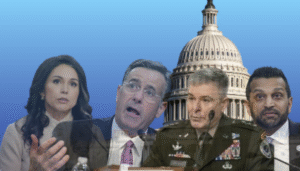

The US intelligence community’s annual threat assessment just dropped. And as ever, it contains some pretty blunt assessments on the world.
Here are the seven bluntest lines, and why they matter.
1) “The United States faces an increasingly fragile global order”
Stay on top of your world from inside your inbox.
Subscribe for free today and receive way much more insights.
Trusted by 160,000+ subscribers
No spam. No noise. Unsubscribe any time.
This is one of several sobering references to the state of the world, the West’s struggle to respond, and the space left for “rogue governments” to, well, go rogue.
The report also captures the dilemma facing the US, whose responses are often seen by rivals as efforts “to contain or weaken them“. To put it another way – in an unstable world, it’s a fine line between deterrence and destabilisation.
2) “An ambitious but anxious China”
That’s the rather neat description of a nation which the spies say is “undercutting US influence” and “driving wedges” between the US and its allies, in an effort to shape a world more favourable to China’s authoritarian system.
At home, the assessment says China’s growth will “almost certainly” keep slowing due to its shrinking population and a collapse in sentiment. And abroad, the report describes China’s efforts “to induce Taiwan to move toward unification” and “intimidate rival claimants” in the South China Sea.
Intriguingly, the text also cites reports that “TikTok accounts run by a PRC propaganda arm” targeted the US 2022 midterms. It’s a big deal, particularly as Congress is due to vote on a bill today (Wednesday) that would force Tiktok’s China-based owner to divest or face a US ban. We’ll brief you on that soon.
3) “This deadlock… is increasingly shifting the momentum in Moscow’s favor”
Separate to Russia’s momentum (helped by uncertainty around future US support), the spooks note Russia has suffered its heaviest losses since WWII, with two results: first, it’ll take Moscow years to recover, making it “more reliant on nuclear, cyber, and space capabilities” in the meantime. And second, it means Putin “continues to face domestic challenges, including support from elites“.
Interestingly, the report also notes that China is supporting Russia just enough, but “without incurring risks” (ie, Western sanctions). In return, it says China gets cheap gas and greater access to the (resource-rich) Arctic.
4) “Iran is not currently undertaking the key nuclear weapons-development activities necessary to produce a testable nuclear device”
This line, along with a finding that Iranian leaders didn’t “orchestrate” or get a heads-up before the Hamas attack against Israel, lowers the report’s heat a little.
Though the document does also highlight Iran’s role in pushing more regional attacks by its proxies; says Iran has still put itself in a “better position” to produce nukes if it so chooses; and Iran “seeks to target former and current U.S. officials” as retaliation for the US assassination of General Qasem Soleimani in 2020. Yikes.
5) “Pyongyang’s cyber forces have matured and are fully capable”
In addition to reiterating Kim Jong-Un’s zero-interest in negotiating away his nuclear program (which he sees as a “guarantor of regime security and national pride”), the report highlights his penchant for “cryptocurrency heists” to raise cash. It’s a reminder that sanctions can produce some unexpected results.
6) “Netanyahu’s viability as leader… may be in jeopardy”
The assessment also says Israel “remains focused on destroying Hamas” though the Gazan population “broadly supports” the group, which will mount “lingering armed resistance… for years to come“.
So in addition to questioning an ally’s political future, the report also effectively questions his strategy. This is pretty big stuff coming from a US threat assessment.
7) “The risks to U.S. national security interests are increasing as the physical effects of climate and environmental change intersect with geopolitical tension”
This isn’t a new conclusion, though the US intelligence folks offer some intriguing examples here, including more competition in the Arctic as sea ice recedes, and “climate-related disasters” contributing to increased migration.
Honourable mentions:
The report also says 74 governments have bought commercial spyware (often to spy on dissidents); and “many Coastal West African governments are facing potential coups“, in part because competition between world powers will presumably limit any international condemnation.
😦
INTRIGUE’S TAKE
Seeing it all condensed into a blunt 42-page package is a little alarming, though there’s really nothing in there too surprising – particularly if you’re a regular Intrigue reader. In fact, we could almost remove some of the jargon, sprinkle in some tasteful lulz, and republish this as an Intrigue special edition.
So another way to think about this is by also looking at the relative emphasis on each challenge: China gets seven pages and Russia gets four, while Iran and North Korea each get three. The Israel-Hamas conflict? It gets one.
Does that match current US priorities? Arguably not. So you could interpret this as a spook’s reminder to Washington’s decision-makers that the US needs to maintain a longer-term strategy while responding to immediate priorities.
Also worth noting:
- The assessment flags the potential for more India-China, India-Pakistan, and Azerbaijan-Armenia conflicts ahead.
- In addition, the report highlights the risk of further internal turmoil in the Balkans, Sudan, Ethiopia, The Sahel, Haiti, and Venezuela.