





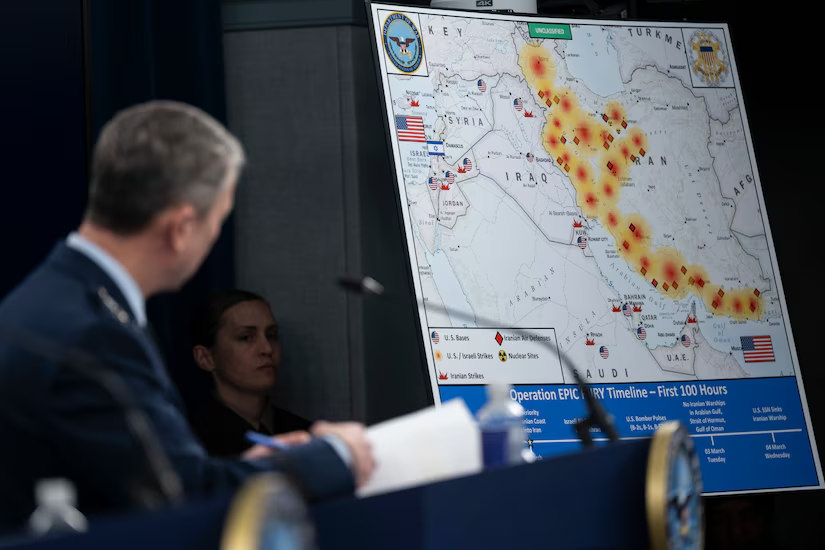
Welcome to day seven of the Third Gulf War which (per a line via Holly Dagres) is now more of a Gulf War than the first two Gulf Wars.
Right now, the three big questions revolve around succession, secession, and suppression (always applaud outstanding alliteration). So let’s start with…
- Secession — will the Kurds launch a ground assault?
Any list of folks denied their own state must include the ~35 million Kurds across eastern Turkey, western Iran, northern Iraq, and northeastern Syria. This ‘greater Kurdistan’ is the size of France and, while home to many philosophies, most want more self-determination.
Stay on top of your world from inside your inbox.
Subscribe for free today and receive way much more insights.
Trusted by 160,000+ subscribers
No spam. No noise. Unsubscribe any time.
That’s inevitably put Kurds at odds with their rulers (Turkey, Syria, Iraq, and Iran), while also drawing them into proxy wars: the Iranians backed them against Saddam Hussein; the Americans backed them against ISIS; the Israelis back them against ~anyone.
And that brings us to a couple of weeks ago: sensing an opportunity in Tehran’s weakness plus US-Israeli backing, six Kurdish groups united to form The Coalition of Political Forces of Iranian Kurdistan (CPFIK). Their founding charter is pretty blunt, seeking…
- “the overthrow of the Islamic Republic of Iran”, and
- “to achieve the Kurdish people’s right to self-determination”.
It aligns the Kurds with other Iranians seeking the end of a “repressive regime” — the young woman (Jina Amini) whose 2022 death triggered mass protests was herself Kurdish.
But the CPFIK’s parallel emphasis on Kurdish self-determination is the wild-card here:
- Some Iranians could fear a broken Iran more than they might want a free Iran
- Regime propaganda has long milked this fear and framed Kurds as disloyal, and
- Those neighbours (Turkey, Syria, Iraq) will resent the US arming the Kurds again.
There’s also the question of why the US is telegraphing this Kurdish strategy so openly — we’ve flagged it could be to provoke the regime into attacking the Kurds and forcing their hand. It could also be to foment a sense of expectation among Kurdish communities.
Either way, it’s not just the Iranians the Kurds are worried about: the US has a long history of using then ditching them (like in Syria literally last month). And… that’s before we recall the Kurds are also out-armed, out-trained, and outnumbered.
- Succession — Who’ll emerge as supreme leader?
Word is the late-ayatollah’s 56-year-old second-born son (Mojtaba) is the favourite, if not in the top job already. It’s possible the regime is deferring any announcement until after…
- a) his father’s funeral (ie religious-cultural reasons) and/or
- b) this US-Israeli war (ie security reasons).
The regime would ordinarily want to broadcast his appointment ASAP to signal strength, though any funeral delay now realistically offers a neat cultural figleaf for his assassination fears (openly fanned by Israeli and US rhetoric).
What’s wrong with Khamenei Jr? He’s a mini-me: a hardliner, insider, IRGC-backed, with crackdown experience (2009), plus a massive fortune (who knew clerics got paid so well!).
Plus from a DC perspective, the idea of blowing billions and torching a region only to end up replacing Khamenei with Khamenei Jr just feels too much like Afghanistan 2.0.
- Suppression — Will Azerbaijan hit back?
It’s still unclear why Iran attacked an international airport in neighbouring Azerbaijan: the country doesn’t host US bases, and it enjoys relatively functional ties with Iran — President Aliyev even signed a condolence book for the ayatollah!
So… why hit Azerbaijan? The main theories include…
- a) Azerbaijan is close to Israel and (let’s be honest) hosts Mossad sites
- b) Iran’s chain of command is broken, and surviving units are trigger-happy
- c) Iran wants to further expand the war’s economic costs (one of the few viable Asia-Europe flight corridors now runs through Azeri airspace)
- d) Iran wants to thwart the Trump Route for Peace & Prosperity (the new transit corridor defusing Armenia-Azerbaijan tensions but side-lining Iran), and/or…
- e) Keep in mind Iran actually denies the attacks altogether, arguing they’re just Israeli false-flag attacks to draw Azerbaijan into the war.
Anyway, the decision to hit the exclave of Nakhchivan (rather than the capital) does have the hallmarks of Iranian calibration to maximise pain while minimising blowback. And either way, Azerbaijan is blaming Iran, warning the attack won’t go unanswered.
Intrigue’s Take
Again, let’s take a look at where this is headed, shall we?
First, on Iran’s munitions, the US is now saying Iran’s daily ballistic missile launches are down 90% since day one, while its drone attacks are down 83%. So yes, Iran’s foreign minister is talking tough to US audiences via NBC, and its attrition strategy continues, but it does seem to diminish with each day.
Second, on estimated timeframes, the US goalposts remain unclear — Hegseth insists this won’t be “endless”, though he’s also insisting the US can and will “sustain this fight easily for as long as we need to.” Plus there are leaks suggesting the Pentagon is staffing up for a conflict to run “through September” or more. That might just be conservative resource allocation, but it’s six or seven months away!
And third, if we’re potentially looking at months more of this, the alliance costs really start to mount: with zero heads-up, US partners and allies are now eating Iranian attacks, energy insecurity, shipping and aviation mayhem, stranded nationals, and maybe now an armed ethnic insurgency, for a war that might last through September, or maybe not.
The risk is even if Iran’s regime breaks, a victorious US emerges more isolated than ever.
Sound even smarter:
- In case you’re wondering, the late ayatollah’s first-born son is a low-profile cleric with no meaningful public role.
- President Trump has encouraged Iranian diplomats around the world to request asylum and help “shape a new and better Iran.”
- Ukraine’s Zelensky says the US and its partners have now used more Patriot missiles in three days than Ukraine has used defending against Russia in four years.