
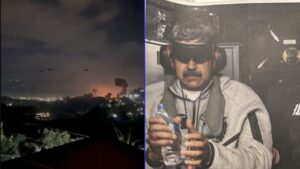


A shackled Nicolás Maduro used his first brief Manhattan court appearance Monday to argue he’s a) innocent, b) still the president of Venezuela, and c) a decent man.
On a) (I’m innocent), the 92-year-old judge (Hellerstein) might eventually get us an answer, though there are some big hurdles ahead — eg, Maduro will claim head-of-state immunity, a ploy that never worked for Panama’s Noriega (the courts deferred to DC). And the DOJ has now dropped its claim the Cartel de los Soles (Venezuelan slang for military corruption) is an actual cartel. It’ll be a couple of years before any verdict.
On b) (I’m president), the Italian-born head of Venezuela’s constitutional court (D’Amelio) has already confirmed Maduro’s veep (Rodriguez) is now in charge.
Stay on top of your world from inside your inbox.
Subscribe for free today and receive way much more insights.
Trusted by 151,000+ subscribers
No spam. No noise. Unsubscribe any time.
And on c) (I’m decent), the ~seven million Venezuelans who’ve fled Maduro’s disastrous regime, or the ~20,000 killed extrajudicially before reaching the border, might disagree.
Meanwhile, Trump officials and advisors keep offering diverging statements: Miller said it’s an “ongoing military operation”, Waltz told the UN it’s a “law enforcement operation”, Hegseth revealed that however you describe it, the move involved 200 US boots on the ground, and Rubio keeps doubling down on the Donroe Doctrine (this is our hemisphere).
But some big questions still loom large, like…
- Was this just an oil grab?
Recall the ancestors to majors like Exxon and Chevron were investing in Venezuela a century ago, but a nationalist president (Pérez) eventually halted that party by nationalising US assets in 1976. Compared to the later radical Chavez-era appropriations, that ‘76 move was negotiated and compensated, but US firms still got burnt — they eventually acquiesced in hopes of retaining access via the new ‘PDVSA’ state oil firm.
But decades of corruption, ineptitude, politicisation, brain drain, and sanctions have seen PDVSA’s output collapse by ~90% since those heydeys. It’s now run (into the ground) by generals and other loyalists, part of Maduro’s strategy to secure loyalty via patronage.
So Trump is now pushing US oil interests front and centre, promising US majors will “go in, spend billions, fix the badly broken infrastructure and start making money for the country.” But these generals won’t just hand over the keys to their font of wealth and security.
Even if you just snatched the keys, Chevron is the only US firm with any real foothold, and can’t simply walk back in and turn the ignition back on. You’re staring down a decade-long, $100B-wide barrel of capital investment to solve Venezuela’s unique geographic, infrastructural, and chemical challenges (it’s mostly extra-heavy sour crude).
And even if you write that big cheque, will Venezuelan judges and generals respect it? If so, for how long? Or will the country devolve into civil war? And at what point does Chevron’s interest clash with China’s interest (Caracas still owes billions).
For an industry that thinks in decades, already navigating the next energy transition, this sudden call to be the vanguard of a polarising and complex intervention is a tough sell. That’s why execs sound so cautious, even if markets have given US oil stocks a nice bump.
It’s all such a steep climb, we wonder the extent to which Trump’s stolen asset rhetoric might just be more an attempt to justify his foreign adventurism to a sceptical audience back home (only a ~third of Americans approve, divided along partisan lines).
The more immediate benefit from Maduro’s capture might be the way it blunts his claims over neighbouring Guyana’s vast oilfields, where US firms are already swimming in cash.
Anyway, those boardroom questions all lead us to….
- Who is actually governing this place?
Legally it’s Maduro’s veep, Delcy Rodríguez, and she’s hustled early to get key factions lined up behind her, even getting an endorsement from Maduro’s son while her own brother (head of the national assembly) runs interference behind the scenes.
So it’s still early days, but the purported logic of Trump’s targeted decapitation strategy is holding for now: the same regime holds the reins, with neither rival elites, armed colectivos, criminal groups, nor guerrillas rushing to disrupt the status quo (yet).
But that can change in an instant — overnight bursts of palace gunfire (seemingly at drones) reveal the jitters, while those colectivo paramilitaries are already cracking down again; they mostly just answer to the regime’s powerful interior minister (Cabello).
And that’s before we get to the beleaguered opposition, which finally united out of sheer desperation against Maduro, with 67% of folks voting him out rather than necessarily aligning with any single vision for what comes next. And yet Trump’s move has legitimised his veep instead.
So that maybe leaves an opposition fractured again, just now into those who’ll a) engage pragmatically with Rodríguez, b) demand an immediate transition, and c) go extreme.
Machado (of Nobel fame) says she’ll now return to Venezuela asap, potentially setting up a dilemma for Trump: what’s his response when she ends up in some Chavista cell, particularly now that she’s just offered to share her Nobel with Trump?
And that leads us to…
- The lurking risk of (more) violence.
There’s always the chance a general or other insider could try their luck, though Maduro himself invested heavily in both carrots (patronage) and sticks (counter-intelligence) to mitigate that exact risk, and past coups have resolved without a full Sudan-style split.
That then leaves non-state actors like the narco-leftist National Liberation Army (ELN) operating across the Venezuela-Colombia border. It’s already vowed to confront Trump’s “imperial plans” and killed several Colombian officers in his name last month. But it’s unclear how much it really wants a fight with Trump, versus how much it’s just using Trump as cover for the war it’s revived against Colombia for more than a year now.
A bigger risk might be the ELN exploiting distracted security forces in Colombia and Venezuela to seize more lucrative mining and drug trafficking corridors.
But the bottom line is this is all completely unpredictable right now, and that’s a core reason why even some of Trump’s supporters still voice unease. Megyn Kelly put it to her listeners like this: “We’re not great at going into these foreign countries, decapitating them at the leadership level, and then saying either we’re going to steer the country to a better place or it’s going to steer itself. Either one. Nine times out of 10, they don’t work out well.”
Intrigue’s Take
If a big part of Trump’s aim was to boot rivals like China, Russia, and Iran, then it’s a little wild Venezuelan state TV made a show of the veep warmly embracing all three ambassadors side-by-side in the front row at her inauguration. But maybe that’s the point: hug who you want, score your points, just don’t cross US lines. Though guess which regimes will be delighted if this all ends up a mess tying down US power and attention?
The other dynamic we’re tracking is across a broader Latin America that’s long accused successive US administrations of effectively ignoring the region. You can see it in the numbers: before WWII, around half of all US presidential trips abroad were to Latin America, but it’s been in decline ever since, accounting for a quarter of all trips through the 1960s, then dropping to ~15% in the latter half of the Cold War, and 5-10% ever since — Biden went three times, and Trump 1.0 visited once.
China’s Xi Jinping? He’s been ~five times, visiting ~11 countries. And he’s not rolling in empty-handed either, but actually bankrolling some massive infrastructure. So to the extent the US ignored its own region because it felt it could, those days are clearly over.
But one lesson here is also to be careful what you wish for: when the US finally turned its gaze back towards Latin America, turns out it wasn’t with a chequebook and a smile. And that’s a worry for many in a region still bearing the scars of prior US interventions.