
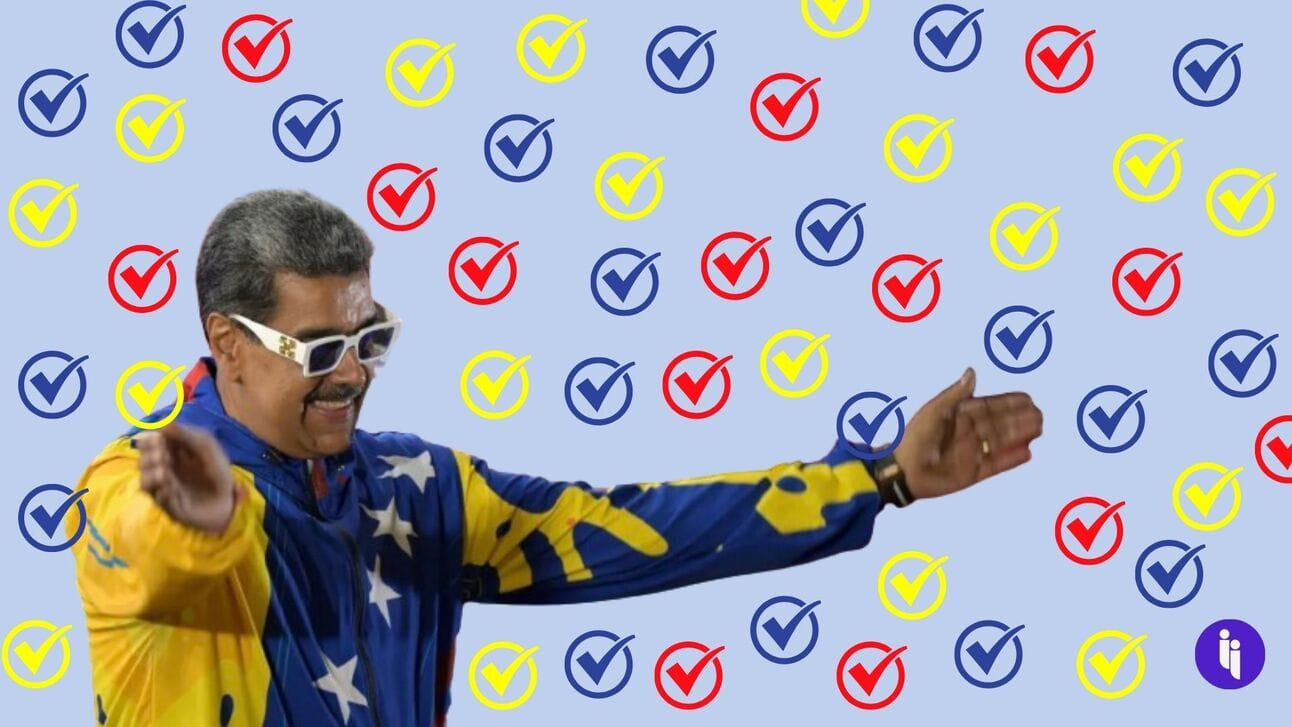
As the sun rises over Caracas this morning (Tuesday), two very different people are still claiming victory in Venezuela’s presidential elections on Sunday: long-time autocrat Nicolás Maduro, and the main opposition candidate and former career diplomat, Edmundo González Urrutia.
Why?
After 11 years of Maduro presiding over an 80% collapse in GDP, the mass exodus of 8 million citizens, and the erasing or co-opting of independent institutions, Venezuela’s famously divided opposition finally managed to unite, even as Maduro kept disqualifying its candidates one by one.
Stay on top of your world from inside your inbox.
Subscribe for free today and receive way much more insights.
Trusted by 160,000+ subscribers
No spam. No noise. Unsubscribe any time.
And all the signs suggested the mild-mannered González (74) could pull it off: credible surveys, exit polls, and quick counts all pointed to his crushing victory.
So what happened?
As the hours inched on beyond 8pm Sunday (when results are typically announced), theories began to spread, until the electoral chief, a Maduro loyalist, emerged on state TV at around 1am Monday and claimed that:
- Maduro had secured 51% of the vote, clinching a third six-year term, and
- González had supposedly fallen short with just over 44% of the vote.
But beyond all the exit polls, there were other immediate reasons for doubt:
- The electoral authority’s website was down most of Monday, and
- Authorities still haven’t released the full vote breakdown, which is mandatory and digitally randomised to prevent falsification (Maduro is blaming a hack by the opposition or foreign powers).
So now what?
The opposition is not only dismissing Maduro’s claimed win, but it’s even brandishing receipts: certified copies of 73% of the country’s 30,000 voting station results (seen in person by a source we trust), adding up to an irreversible González victory.
And the opposition has some remarkable backing, too:
- At home, protests have erupted in cities across Venezuela, pouring out of vast impoverished settlements that Maduro claims as his base, while
- Abroad, the UN, the US, and the EU – plus influential left-leaning players from Brazil, Colombia, and Mexico – have called for transparency, while Chile’s president has flat out said the results are “hard to believe”.
So as protestors approached Maduro’s palace Monday evening, the man himself appeared on state TV and delivered a 69-minute address, variously describing those out in the streets as “criminals”, “terrorists”, “fascists”, “drug-addicts”, and “a violent 10%” serving “ultra-right” forces (plus “the gringos”).
And yet at both home and abroad, Maduro wasn’t alone either:
- At home, right on camera, he repeatedly gestured to a military chief on his left, and a police chief on his right. The message? “I’m still in control.”
- And as for abroad? He’d just spent the day accepting congratulatory messages from states like Russia, China, Cuba, and Iran.
Then, after deriding the protestors as “counter revolutionaries” and vowing ominously that “justice will be done”, he wrapped it up with “good night, Venezuela”, while his police and paramilitaries clashed with folks outside.
As for next steps? The opposition is calling on families to gather in nationwide “popular assemblies” this morning, reiterating their demand for Maduro to go.
INTRIGUE’S TAKE
Some of the most remarkable images have shown crowds pulling down at least three statues of Hugo Chavez, the leftist ex-general and Maduro’s mentor, who ran the country for 14 years before dying of cancer in 2013.
Of course, images like that give serious end-of-Saddam-Hussein vibes, but there are a few reasons why things might not work out that way:
- First, Maduro himself is a famously superstitious and stubborn leader, with little inclination to bend, and a lot to lose if he does (given DC’s $15M bounty for his capture on trafficking and other charges)
- Second, his own loyal (and US-sanctioned) defence minister also has a lot to lose, so has spent the last decade ensuring loyalty among the armed forces while installing key allies into crucial positions, and
- Third, whatever isolation the international community can impose, it’s now increasingly being diluted by the queue of foreign autocrats only too willing to endorse Maduro’s win in this new multipolar world.
And that last point begs the question: what’s in it for Russia, China, Cuba, Iran, and the others? They probably have three audiences in mind:
- With a nod to the US, it’s a way to nourish instability in its region, highlight the limits of US influence, and add to the distraction it’s already facing in Europe, the Middle East, and back home
- To those regimes’ own citizens (who are getting a carefully filtered version of reality via state media), it all feeds their claim that history is bending towards alternatives to a US-led model, and
- To the dozens of fence-sitting leaders around the world, it’s a signal that while they might be on the receiving end of some angry tweets or sanctions, they too can ride out Western pressure and join the club
So that’s a lot riding on the shoulders of some brave and angry Venezuelan citizens, who are now figuring out what card to play next.
Also worth noting:
- Maduro has cut ties with various countries that have questioned his win.
- He ‘won’ the last election in 2017 after the beleaguered opposition boycotted the process.
- Some opposition figures are now taking refuge in the embassy of Argentina (Maduro has described Argentina’s president as a “Nazi”).