



Two crucial but seemingly unconnected things happened this week:
- The US seized an oil tanker off the coast of Venezuela, and
- An Eastern European dictator met a Venezuelan ambassador.
Now let’s connect some dots:
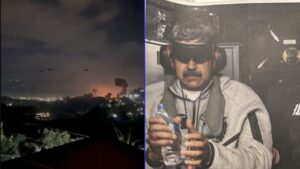
Dot 1 – Tuesday 10 December: the US attorney-general publishes a video of US troops descending from a chopper onto an oil tanker, with a caption that they “executed a seizure warrant for a crude oil tanker used to transport sanctioned oil from Venezuela and Iran”.
Stay on top of your world from inside your inbox.
Subscribe for free today and receive way much more insights.
Trusted by 151,000+ subscribers
No spam. No noise. Unsubscribe any time.
The tanker, named the ‘Skipper’, has been under US sanctions since 2022 on allegations it’s part of an illegal oil shipping network (it spoofs its location and uses false flags).
Dot 2 – Thursday 11 December: the Venezuelan ambassador to Russia walks into a richly decorated room in the Belarusian presidential palace to meet dictator Aleksandr Lukashenko, their second sit-down within three weeks.
We’re not privy to their chat, but it’s weird for an envoy to get so much presidential access so far from home. And Lukashenko did hint the pair had previously “agreed that [the ambassador] should clear some matters with the leadership of Venezuela”. Interesting…
No clear picture yet? Let’s add some background.
On the Venezuela side, President Trump is clearly hustling to oust Maduro — you can connect the dots, whether…
- Doubling the US bounty on Maduro’s head to $50M
- Deploying the Caribbean’s biggest naval build-up since the Cold War
- Blowing alleged narco-boats out of the water
- Threatening to start hitting targets on land, and now…
- Buzzing jets over the Gulf of Venezuela (which Caracas claims).
But if you don’t feel like connecting any dots, you can also just listen to Trump at this point — he said the loud bit louder this week, warning Maduro’s “days are numbered”.
Outlets in Miami (with a large Venezuelan diaspora) and beyond suggest it’s working: there are reports Maduro has offered to step down if the US drops sanctions and grants full amnesty for him and his family. But if you’re wondering how Trump responded, the US just expanded its sanctions to now include three of Maduro’s nephews. I.e., offer denied.
So here’s where Lukashenko comes in.
Dot 3 – Putin is one of Maduro’s few remaining ‘friends’, while the ex-Soviet Belarus is virtually one of Putin’s vassal states at this point: Lukashenko hosts some of Putin’s nukes, and even let Putin invade Ukraine from Belarusian territory!
But then curiously, that friendship triangle becomes a bit of a square because of the Trump administration’s move to thaw US ties with Belarus. While these efforts have yielded some transactional results (Lukashenko released a bunch of political prisoners), the broader US strategy in Belarus isn’t entirely clear, with theories ranging from…
- Maybe Trump wants to peel Belarus away from Putin, to
- Maybe Trump wants to influence Putin via Belarus.
Either way, this friendship square now seems to have produced Maduro’s most plausible off-ramp to date: he’s rejected any exile in Russia (too far), while the US rejects any exile in Cuba (too close).
So Belarus is emerging as the hybrid option maybe everyone can accept:
- It’s tolerable for Maduro, who ends up on the edge of Europe but with Russian-backed security, without having to back-track on his own Russia rejection, and
- It’s tolerable for the US, as it side-lines Cuba without emboldening anyone else (like Putin) theoretically capable of undermining US power in its own region.
Dot 4 – So when Lukashenko publicly encouraged Maduro to come visit Belarus the other day, he might’ve been a little more serious than we realised.
Intrigue’s Take
There was a sneaky detail above that’s worth exploring further: the US is accusing the ship it seized off Venezuela of transporting oil for Venezuela and Iran.
These two rogue players (along with North Korea, Russia, and others) don’t have much in common beyond their shared interest in ushering in a post-US-led world. But it’s actually in oil markets where their cooperation goes beyond photo opps and press releases.
While both Iran and Venezuela face oil sanctions, Iran’s are tougher and more strictly enforced. As soon as Iran loads oil at its Kharg Island, that triggers red flags everywhere. The result is the shadow fleet servicing Venezuela has maintained more access to insurance and ports, enabling it to offload its oil at higher prices.
Venezuela’s waters (especially around Amuay and José terminal) are also among the few places left where massive dark-fleet transfers can still happen with almost no oversight.
So Iran has no shortage of oil, but blending its crude with Venezuela’s output (where technically possible) solves lots of problems. Ditto, seizing the Skipper sends a message to two US foes at once.