





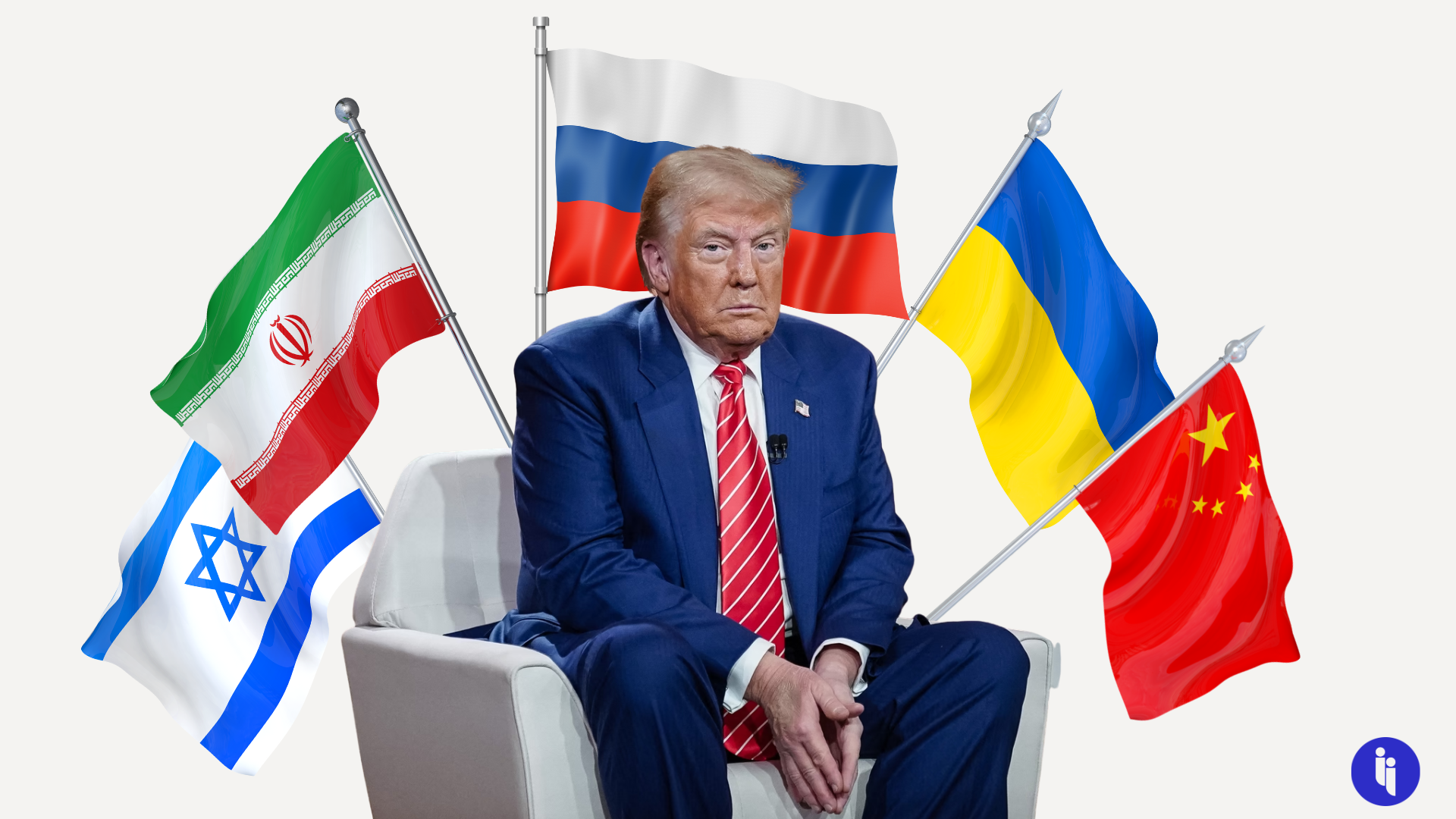
Donald Trump promised to deliver “the most extraordinary first 100 days of any presidency”. Promise made, promise kept. Let’s whittle down President Trump’s many foreign policy promises to the four most consequential and take stock of where we are.
1. Rebalance trade (particularly with China)
President Trump promised to reshape America’s trade relationship with the world, lamenting that the US “[was] carrying other countries on our back with, you know, with trade numbers, with horrible numbers, and we’ve changed it.”
Enter “Liberation Day” and the chaotic rollout (and retraction) of tariffs. Based on statements from Trump’s trade and economic teams, the tariff regime appears to have been designed with several competing outcomes in mind:
Stay on top of your world from inside your inbox.
Subscribe for free today and receive way much more insights.
Trusted by 161,000+ subscribers
No spam. No noise. Unsubscribe any time.
- To raise revenue to address the US deficit and to remedy “unfair” trade imbalances (particularly with China)
- To be used as leverage in exchange for broad macroeconomic concessions (particularly from China)
- To re-shore US jobs and industrial capability (particularly from China)
Can you see the common thread? Hint: Your grandma only gets it out for special occasions.
So, how does this end? Treasury Secretary Scott Bessent told CNBC on Monday that he expects “China to de-escalate, because they sell five times more to us than we sell to them, and so these 120%, 145% tariffs are unsustainable.”
Precisely how China and other countries go about de-escalating isn’t clear – prominent monetary policy expert Barry Eichengreen has said that Chinese and European central banks aren’t in a position to lower their interest rates (🇫🇷) and revalue their currencies like Trump wants.
2. End the Russo-Ukraine war
During his campaign, Trump repeatedly said, “If I’m president, I will have that war settled in one day, 24 hours.”
While the previous administration was hesitant to push Kyiv into negotiations, Trump has tried to force President Zelensky’s hand by calling him a “dictator without elections”, while warning him that he has “no cards to play.”
Putting aside Trump’s trademark hyperbole, the president must have hoped his more ‘direct’ approach would have borne some fruit by now. Instead, Russia has rejected several temporary ceasefire proposals, and a mooted minerals-for-security deal with Ukraine has faded into the background.
That said, two permanent ceasefire deals were leaked last week (one from the US and the other from Ukraine and Europe), suggesting a deal might be closer than we think.
3. Secure a ceasefire in Gaza and the release of hostages
During his inauguration speech, President Trump said, “The hostages in the Middle East are coming back home to their families.” He has also said he would “like to see an end to the war.”
Since returning to office, Trump has helped secure the release of 26 American hostages from Afghanistan, Kuwait, Russia, and Gaza. He was also instrumental in securing a 42-day ceasefire between Israel and Hamas on 19 January (the day before he came to office), including the release of 33 Israeli hostages. Both were early wins for Trump’s foreign policy.
However, since that early ceasefire deal, Trump has backed Israeli Prime Minister Benjamin Netanyahu’s decision to walk away from the ceasefire in March, and Israel’s attacks on Hamas in Gaza and Hezbollah in Lebanon are continuing.
4. Bring back his “America-first” brand of diplomacy
One of the more memorable lines from President Trump’s inauguration speech was that “America [would] reclaim its rightful place as the greatest, most powerful, most respected nation on earth, inspiring the awe and admiration of the entire world.”
To achieve that, his administration began a sweeping overhaul of the US foreign policy establishment. He has all but closed USAID, cut State Department funding, and is considering closing 30 US embassies around the world.
Trump has also taken the US out of the Paris Climate Agreement (for the second time), mused about acquiring Greenland and the Panama Canal, and threatened to annex Canada.
While his advisers might laugh off his more unorthodox ideas as jokes, foreign countries aren’t amused. The world senses that Trump’s foreign policy is either a risk to be managed, a generational opportunity to fill the emerging power vacuum, or both.
Intrigue’s Take
If there’s one thing English classes in secondary school prepare you for, it’s picking out the main themes of a work you didn’t fully understand and aren’t entirely convinced the author did either. Accordingly, we offer the following three themes from the Trump administration’s foreign policy so far:
- China is an adversary that must be isolated economically and diplomatically
- A belief that the future strength of the US military relies on rebuilding its industrial base
- A belief that foreign policy is, at its core, transactional and not reciprocal.
On China, Trump was lauded during his first term — rightly in our view — for calling out China’s manipulative economic practices. But it is clear his approach to Beijing is more radical this time, and that the US-China relationship is now adversarial rather than simply competitive. Trump’s team wants to force Beijing to negotiate, but the Chinese Communist Party is highly unlikely to negotiate from a position of weakness.
As for rebuilding US industrial capability, Trump is right that in a more fragmented world, military power will be closely linked to domestic industrial capability. The problem is that the US cannot re-shore its industrial capability to the level required and will have to rely on allies and trade partners in the long term.
As for his worldview, Donald Trump is finding out that using leverage can only get you so far. As Mark Carney’s improbable re-election in Canada yesterday shows, foreign countries have agency and will make decisions based on their own interests.
For the most instinctive and effective populist of his generation, it is strange that when it comes to dealing with other countries, Trump seems to forget that all politics is local.