



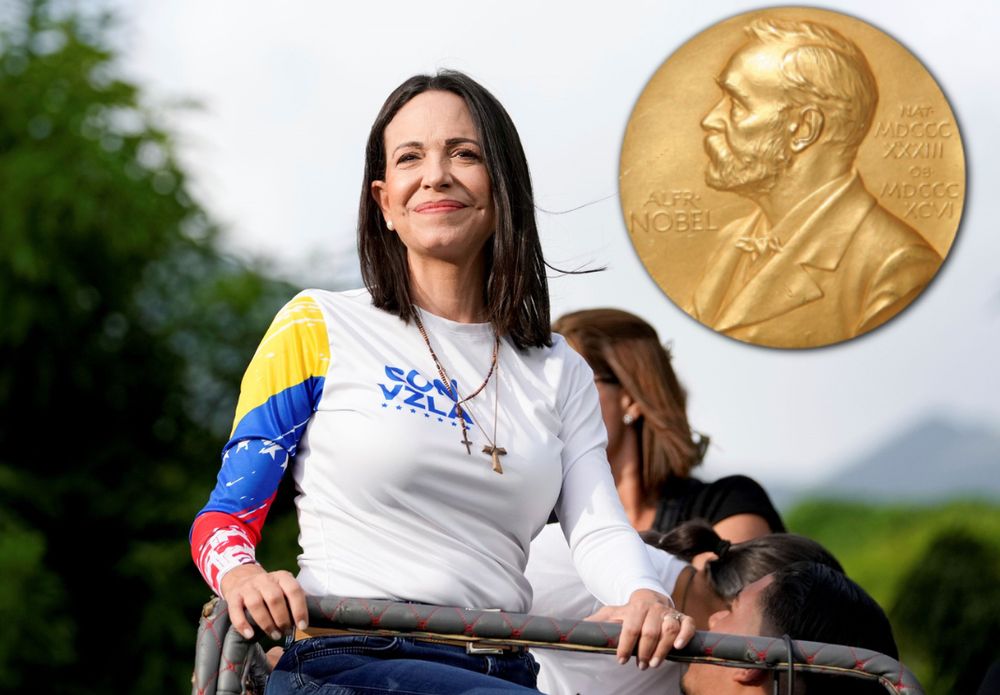
Moments ago, the Nobel Committee awarded Venezuelan opposition figure María Corina Machado the 2025 Nobel Peace Prize for her efforts to “keep the flame of democracy burning amid a growing darkness”.
She’s currently in hiding as she continues to campaign against Venezuelan dictator Nicolás Maduro. We’ve shared some initial thoughts on her remarkable win below.
But in the meantime, what better time to take a quick look at this coveted honour?
Stay on top of your world from inside your inbox.
Subscribe for free today and receive way much more insights.
Trusted by 161,000+ subscribers
No spam. No noise. Unsubscribe any time.
Every year since 1901, five Norwegians (not randoms, but a committee chosen by parliament) have locked themselves in a special room in central Oslo’s Nobel Institute to make one of the toughest decisions of our time: what to watch who should win.
The hardest part of getting nominated is finding a government, ICJ judge, professor, laureate, or past committee member willing to nominate you. After that, you sit tight and hope (if you’re even aware of the nomination) you’ve done more peacemongering than this year’s 337 other nominees to win the 11 million Swedish kronor ($1.1M) cash prize.
Speaking of Sweden, Swedish academies handle the scientific Nobels, but the Peace Prize has always been a Norwegian project, and a deeply geopolitical one at that. Why?
First, it’s a mirror.
Take Andrei Sakharov, the dissident Russian nuclear scientist and human rights defender who won the 1975 prize at the height of the Cold War, prompting Moscow to complain of anti-Soviet propaganda.
Second, it’s a window.
Those Norwegians didn’t flinch, going on to dish the 1983 prize to Polish electrician Lech Wałęsa for his glimpse into how the world ought to be — it was a huge morale boost for his underground Solidarity movement that ended up ousting Communist rule in 1989.
Ditto, the committee was focused on intention when it dished the award out to Barack Obama barely nine months into his presidency, in a move later regretted by a top Nobel insider (the president himself suggested at the time that he was unworthy).
And speaking of regrets…
Third, it’s a marker.
While a winner like Nelson Mandela goes to glory for his role in dismantling Apartheid, it doesn’t always work out that way. Take Myanmar’s democracy champion Aung San Suu Kyi, whose 1991 win (from house arrest!) now sits under the shadow of her later silence on Rohingya persecution as an elected leader.
Ditto Ethiopia’s leader Abiy Ahmed, whose 2019 win suited his peace efforts with Eritrea next door, until he started facing war crime allegations in Tigray back home two years later. That whole spat continues to fester (see our map section below).
And fourth, it’s a barometer.
While it was the Soviets railing against the prize last century, you can learn a lot from who’s been objecting this century. Take the 2010 award for China’s Liu Xiaobo, the jailed dissident who later succumbed to cancer during his 11-year sentence for ✌️subversion✌️.
An angry Beijing labelled the committee “anti-China” and ended up not only freezing ties with Norway for six years, but even banning Norwegian salmon imports. Sensitive much?
And you can probably guess what happened when the Norwegians honoured imprisoned Iranian women’s rights activist Narges Mohammadi in 2023: the mullahs railed against this “interference in domestic affairs”. Unfazed, the committee still calls them a “regime”.
And these objections merely confirm what we already know: the world really does care about the Nobel Peace Prize. If you needed further proof, look no further than its various imitations, whether the Kremlin’s old Lenin Peace Prize, or Beijing’s Confucius Peace Prize.
As the old saying goes (which we absolutely just made up): if you can’t win, just invent your own prize.
Intrigue’s Take
Awarding the 2025 prize to Venezuela’s Corina Machado is, in addition to her merit, a deft political move by the Nobel committee given all the debate around President Trump’s own Nobel prospects, as she actually has a bit in common with the US leader.
First, she’s no bleeding-heart liberal, but a staunchly conservative voice. So it’s hard to frame this as a partisan or ideological slight being dished out from Oslo.
And second, Corina (like Trump) absolutely rejects the Maduro regime’s illegal grip on power. So much so, she continues to live clandestinely in Venezuela while her supporters are routinely kidnapped (her campaign organiser Maria Oropeza was hauled off the streets last August). So this is a laureate Trump respects.
Her win also undermines Maduro’s claims that any opposition must be part of some gringo plot. Turns out the world’s most prestigious prize agrees with the gringos too.