





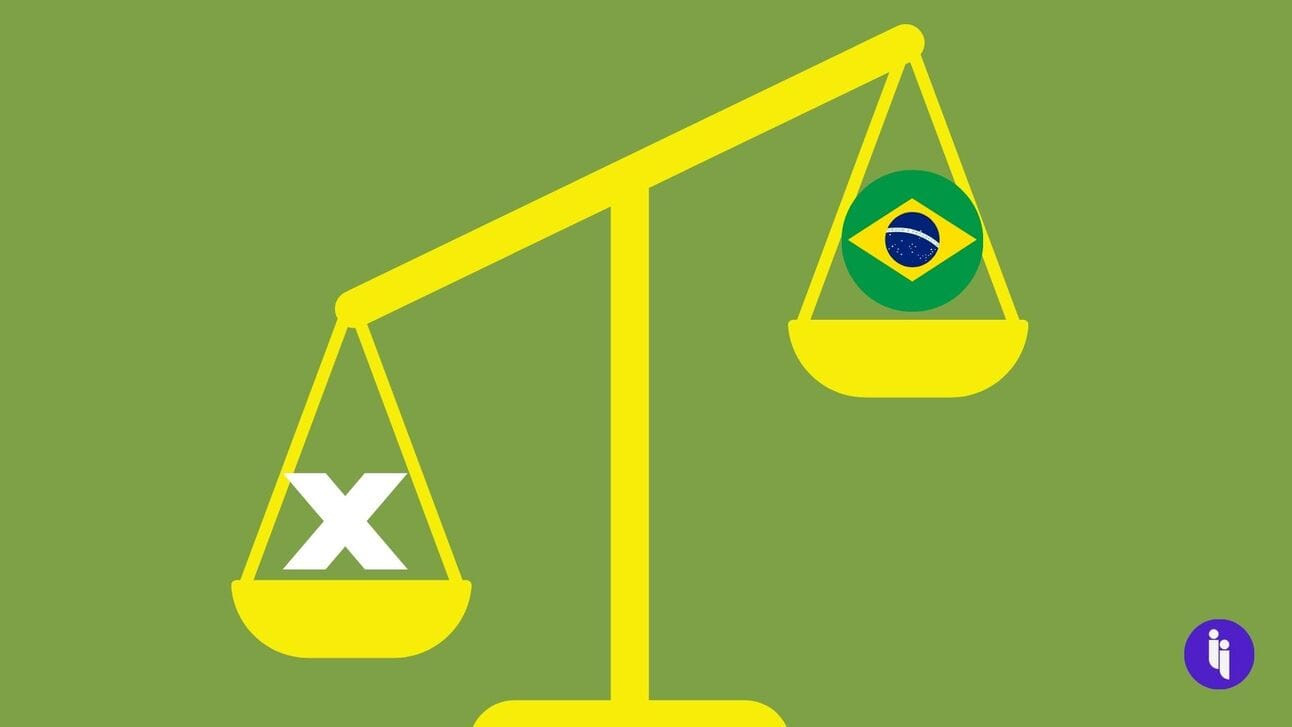
In the late hours of Saturday as you were fast asleep or deep in a Negroni haze, Elon Musk was closing shop on X’s Brazil offices, putting the blame squarely on one man – Brazilian supreme federal court judge, Alexandre de Moraes.
The Moraes-Musk feud, though, goes back months. And the judge’s quest to protect Brazil against what he deems “disinformation”, even further.
Here’s what happened. On Saturday, Musk’s team alleged Moraes had secretly threatened to arrest the firm’s legal rep in Brazil if X (née Twitter) didn’t comply with the judge’s orders from back in April. So Musk said he was closing his Brazilian office altogether, though local users can still tweet, like, and lurk away.
Stay on top of your world from inside your inbox.
Subscribe for free today and receive way much more insights.
Trusted by 160,000+ subscribers
No spam. No noise. Unsubscribe any time.
So… what happened back in April? Moraes, with whom Musk has sought to build bridges by nicknaming him “Brazil’s Darth Vader”, ordered X to block certain accounts accused of spreading disinformation and inciting hatred.
Those orders are typically sealed from public view (presumably to avoid the Streisand effect), but many of the accused tweeters are reportedly fans of Jair Bolsonaro, Brazil’s former president.
He’s the ex-leader accused of spreading disinformation about Brazil’s voting system, and inciting riots to disrupt the transfer of power after he lost an election. He denies all charges, which he says are political. But there’s a bit of a love-hate triangle here, too, because:
- Judge Moraes led last year’s trial that banned Bolsonaro from elected office until 2030, then ordered the seizure of his passport, and
- Bolsonaro personally draped Musk with one of Brazil’s top honours back in 2022 (apparently the medal’s first such foreign recipient).
But it’s not just Brazil. Since buying Twitter in 2022, Musk has wound up publicly feuding with leaders and judges across the world —
- In Pakistan, authorities blocked X around February’s elections, after claiming X ignored gag orders when the opposition called for protests
- In the UK, Keir Starmer was barely in office a month before a clash with Musk, who objected to authorities charging people over social media posts that breached UK laws against inciting hatred and unrest, and
- The EUcontinues to investigate X under its far-reaching Digital Services Act, with allegations the platform’s blue checkmarks, ad transparency, and researcher tools don’t meet standards.
And lest you think this is all just about Musk, Brazil’sMoraes has also previously moved against Telegram on disinformation grounds, while other countries have feuded with platforms for all kinds of reasons —
- TikTok is scheduled for a US ban in 2025 (unless it’s sold) on the grounds that it’s a ‘foreign adversary controlled application’ (China)
- Turkey just blocked Instagram for nine days, objecting to the censorship of posts commemorating an assassinated Hamas leader, and
- Russia blocked Instagram and Facebook on ‘extremism’ grounds, to suppress dissent after launching its full-scale invasion of Ukraine.
So as big as Musk and Moraes may be, there’s much more going on already.
INTRIGUE’S TAKE
What’s going on, you ask?
While Musk and Moraes duke it out, they’re arguably just the inevitable (if colourful) symptom of a much deeper, more consequential issue: tech is a globalising force, and it’s now clashing with a deglobalising world.
You could say Musk and Moraes are merely accelerating that clash.
So then… where does this lead? There are a few paths unfolding: first, China has now effectively created its own internet, while Russia has made a similar (if weaker) attempt. But very few states have the wherewithal for this.
Second – political, regulatory, legal, and industry egos will keep moving to make their name as champions of social cohesion, the national interest, the rule of law, and/or free speech. And that’ll push ad-hoc shifts in each country.
But third, the EU has sniffed out an early-mover opportunity as regulator-in-chief via its Digital Services Act. By seeking to set the rules of the road, it’s also hoping to provide a plug-and-play package for the rest of the world: rules that the platforms already know (if not love), and which purport to set a transparent balance for capitals to draw red lines without imposing full bans.
If Brussels pulls this off, it’ll give the EU a lot of new geopolitical clout, while making quite a few new enemies in Silicon Valley.