



🌍 Merz does China
Plus: Spain’s 156 secret docs

|
Today’s briefing: |
|
Good morning Intriguer. We all have biases. At Intrigue, we do our level best to stress test ours, but anyone who denies they have them is trying to sell you a bill of goods you ought not buy.
So what are yours I’ll go first: the Chinese government sees the world as zero sum (but will tell you everything is win-win), they believe China is the centre of the world and have a chip on their shoulder about it, and as a result of the first two, China is really bad at playing nice with others.
To be clear, some of the best years of my life were spent in China — the people, the culture, the country itself are remarkable. The hours spent in drab office buildings being yelled at by mid-ranking officials were less so.
I share all this because our top story today is about Chancellor Merz’s trip to China. Germany, and Europe writ large, are really hoping my take is wrong. They’re hoping that China, faced with the generational opportunity of the US kicking itself in the diplomatic nether-region, will prove to be an open and forthright partner for the rest of the 21st century.
Which raises maybe the question of our geopolitical moment: can a global power change its spots? Or are they, to quote my favourite sports press conference meltdown of all time, exactly who we thought they were?

Quote of the day
“There is no reason why we cannot get along well with the United States”
That's none other than North Korean supreme leader Kim Jong Un, though he added the little caveat that DC must first drop its opposition to North Korea's nuclear weapons.
The Old Continent’s balancing act

President Xi could just leave his red carpet out on the tarmac at this point: France’s Macron was there in December, then in January he welcomed Canada’s Carney, Finland's Orpo, and the UK’s Starmer, until Germany’s Friedrich Merz landed just this week.
But don’t let all Europe’s social feed China-maxxing distract you from the bigger picture.
If you think about it, some of Merz's biggest problems now intersect with China.
First, there’s Germany’s economy, which has basically flatlined for six years. What’s that got to do with China? Look at those trade numbers:
-
Germany’s exports to China are down almost a quarter since 2022, while China’s sales back to Germany spiked 10% last year alone. Or to put it another way, Germany’s trade deficit with China has quadrupled since 2000.
And while trade deficits can be normal, in China’s case they can point to two things:
i) Xi’s big Made in China strategy (backed by vast state subsidies) has launched his country up the value chain to the point where, instead of buying advanced stuff from Germany, China now makes its own — that not only means buying less from Germany, but also eating into Germany’s market share around the world.
And to give you a sense of the scale, Germany’s auto exports to China are now down 66% since 2022!
ii) The other economic factor on Merz’s mind is his big supply chain reliance on China, with ~200 German product groups still flagging a major dependency on China for things like the critical minerals, chemicals, and chips needed for EVs, turbines, and defence.
And taking these two together, that second problem (supply chains) makes it hard for Merz to tackle the first (value chains). How? The moment he or the broader EU moves to probe China's unfair practices, Beijing just threatens Germany’s access to key inputs.
It all helps explain Merz’s rhetoric (and entourage of CEOs) on this China trip, describing Germany-China economic ties as "unhealthy", and calling for fairer market access, all while smile-maxxing with Xi on the red carpet.
The second China-thing on Merz’s mind is Putin’s invasion on Europe’s doorstep, backed by China’s oil-buys and industrial capacity, and launched just days after Putin and Xi declared their famous ‘no-limits’ partnership. We just explored Ukraine on Tuesday, but suffice to say Merz has already raised it with Xi.
And the third thing on Merz’s mind here is realistically-if-indirectly… the US! The German leader has been at the forefront of capitals declaring the old US-led world order dead, partly (in his view at least) as a result of Trump 2.0 abdicating that US leadership role, but also as rivals like China and Russia seize the opportunity to shape whatever comes next.
So that airport red carpet greeting Western VIPs in Beijing? Maybe it’s more a tightrope.
Intrigue’s Take
China is a massive power that's not going anywhere, so engagement isn’t optional.
But the experience of Merz and the conga line of Western leaders before him reminds us how much today’s engagement with China is such a tightrope.
First, some criticise Merz et al for dunking on US abdication then jetting to authoritarian China the next day, but dismissing it all as hypocrisy doesn’t get you very far. The reality is this is how world leaders play their cards when caught up in Great Power CompetitionTM .
Second, it’s a tightrope, but they’re not running from the US any more than they’re running to China. Rather, in hedging against a less predictable USA, they’re naturally trying to shape a more assertive China, even if such an endeavour is glacial if not futile.
Third, those first points above complicate how the world now grapples with what’s now our second China Shock (this higher-tech export flood; the first shock was China’s post-WTO flood of cheaper stuff btw).
An effective response to this latest Shock might’ve been banding like-minded economies to then jointly negotiate with China — but that idea (eg, the CPTPP trade pact) fell to the same populist forces fanned by the first China Shock. So the result is we're now literally watching the opposite strategy play out, with Western leaders like Merz, Starmer, Carney, and Trump (in April) each traipsing to China individually, trimmed leverage in hand.
Sound even smarter
-
Back in October, German foreign minister Johann Wadephul cancelled his China trip after Beijing authorities ghosted him, agreeing to only one of his requested meetings.
Meanwhile, elsewhere…

 |
🇪🇸 SPAIN – Old ghosts. Comment: The document dump seems to reinforce what we already knew: eg, that the king (father of the current monarch) was ordering plotters to stand down, with no evidence he was onboard. Still, lobbing these docs into today’s polarised Spain plays to broader debates around government transparency, with the conservative opposition dismissing it as a distraction from Sánchez’s scandals. Meanwhile, the failed coup leader (Tejero) actually just died at 93 on the day of the document release. |
 |
🇨🇺 CUBA – Boat incursion. |
 |
🇮🇳 INDIA – Howdy partner. Comment: These two share key interests: for example, they both see terrorism as an existential threat; and they both see their tech sectors as future-shaping strengths. |
 |
🇯🇵 JAPAN – Island missiles. Comment: As always, the timing is interesting: it comes just after China’s latest escalation (export curbs on 20 military-linked Japanese firms), and just before PM Takaichi’s planned March visit to the US (highlighting her alliance cred). |
 |
🇮🇸 ICELAND – Nice Union, might join later. Comment: The Icelanders ditched earlier EU talks over fisheries and other economic issues. This new interest comes amid US rhetoric around Greenland and broader NATO (which Iceland joined as a founding member). Polls on whether to join the EU are currently split. |
 |
🇦🇺 AUSTRALIA – Showstopper. |
 |
🇧🇷 BRAZIL – Neck and neck. |
 |
🇿🇼 ZIMBABWE – Resource nationalism. Comment: Zimbabwe has (with Indonesia) been a front-runner among resource exporters trying to onshore more of the value-add (processing). Indonesia's move drove a 10x surge in processed nickel exports within five years, while massive new China-backed smelters created 500k direct new jobs. More exporters will want to replicate those numbers. |
Extra Intrigue
The Intrigue jobs board
-
Paid Intern @ Inter-American Development Bank in Washington DC
-
Technical Assistant, Education @ Norwegian Refugee Council in Mexico City
-
Political Officer @ British Office Sudan in Cairo
Carnival of the day
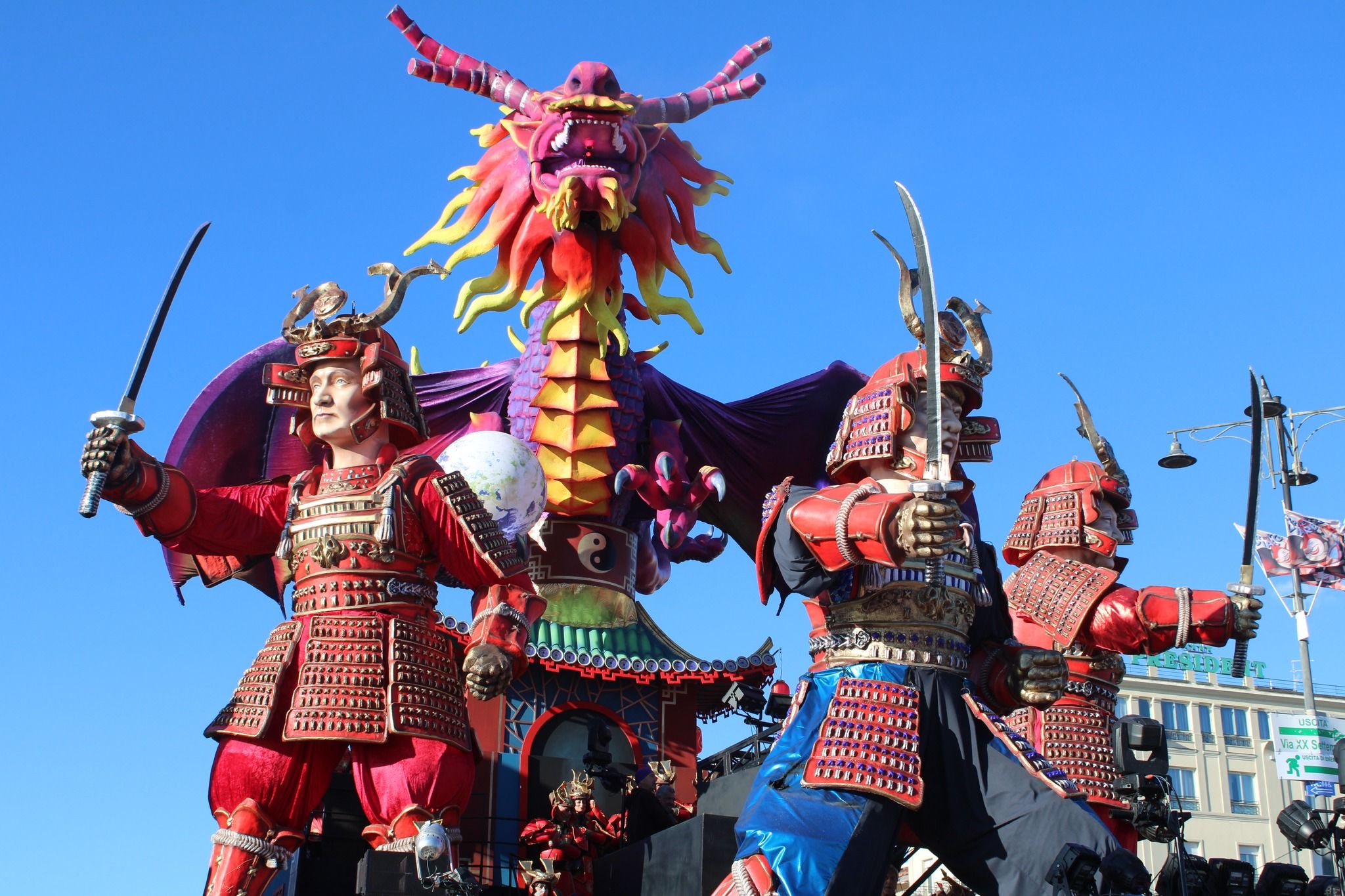
The float titled ‘Samurai of Power’. Credits: Michelangelo Buonarroti via Facebook.
If we say ‘Carnival’, your mind might run to Rio’s colourful, exuberant, and scantily-clad street extravaganza, or even Port of Spain’s Soca-Calypso version.
But as geopolitics nerds intrepid travellers, you might also consider the carnival that’s been running in the small Italian city of Viareggio for 150 years.
This one is less about Samba or feather wings, and more about huge moving tableaux that dunk on mainstream themes. Eg, the above second-placed float stars President Trump, China’s Xi, and Russia’s Putin dressed as samurai warriors. And the bronze medallist features the EU’s Ursula von der Leyen laying bombs instead of eggs.
The fact these two placed so highly hints at Italy’s creeping preoccupation with the world around it. But it’s not all doom — the winner (by artist Luca Bertozzi) is an uplifting play on the Little Red Riding Hood tale, reframing fear as opportunity.
Today’s poll
What do you think is in Europe's best interest? |
Yesterday’s poll: Which past world leader do you think gave the best speeches?
🇬🇧 Winston Churchill (60%)
🇹🇼 Tsai Ing Wen (1%)
🇿🇦 Nelson Mandela (22%)
🇺🇸 Franklin D. Roosevelt (10%)
🇵🇰 Benazir Bhutto (1%)
✍️ Other (write in!) (5%)
Your two cents:
-
🇬🇧 J: “Winston had a leg up on most politicians with his ability to articulate and deliver powerful ideas. The tenor in his voice alone was enough to build confidence in the most dark of times.”
-
Honourable mentions: Abraham Lincoln, Ronald Reagan, Julia Gillard, Barack Obama, and Thomas Sankara.