




Thousands of South Koreans hit the hay last night (Tuesday), blissfully unaware that by sunrise, the country would have flirted with martial law then quickly hit ctrl-z.
South Korea’s president, Yoon Suk Yeol, kicked things off with an unexpected late-night national address declaring martial law, citing “threats posed by North Korea’s communist forces” and a need to “eliminate anti-state elements.” Here’s a quick timeline:
- ⏰ 10:23pm — President Yoon announces emergency martial law
- ⏰ 11:00pm — Martial law kicks in
- ⏰ 11pm–midnight — Lawmakers scramble to the legislature, jumping over perimeters and wrestling through police barricades
- ⏰ Midnight-3:00am — Anti-president protestors rally outside
- ⏰ 12:48am — Enough lawmakers make it inside to meet the minimum 150 threshold, while fending off military attempts to break in and block any vote
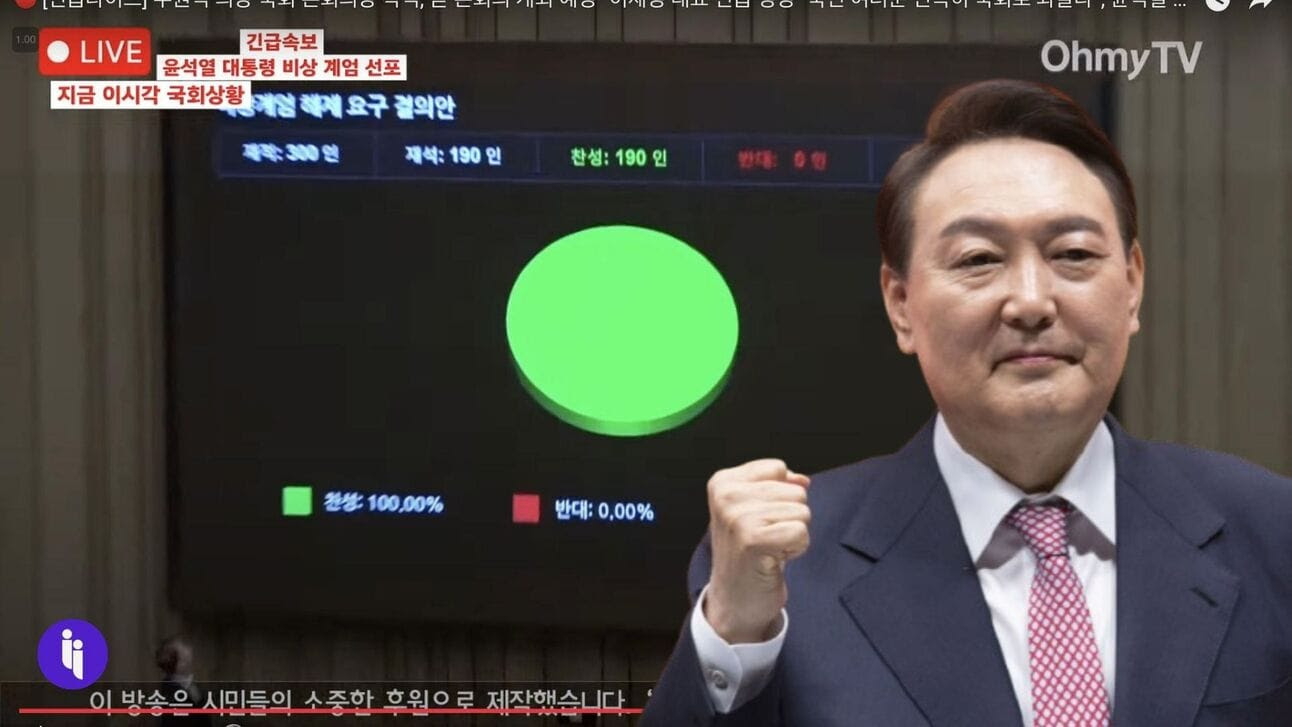
- ⏰ 1:04am — Legislature unanimously (190-0) declares the martial law invalid
- ⏰ 4:26am — President Yoon accepts the rebuke and withdraws his decree
Never mind, then? President Yoon’s move was, ahem, bold considering his 19% approval rating and his party’s minority in the legislature. But it was also a major shift from South Korea’s modern political norms: martial law was common for much of the 1960s and 70s, leaving a bitter legacy (which Nobel Prize winner Han Kang has chronicled) — so to suddenly have martial law again for the first time since Korea’s 1980s democratisation will have been a tough pill for many to swallow this morning.
Stay on top of your world from inside your inbox.
Subscribe for free today and receive way much more insights.
Trusted by 161,000+ subscribers
No spam. No noise. Unsubscribe any time.
So why’d he do it?
There was no sudden threat from Pyongyang. That’s right, no en masse trash balloons, no military manoeuvres, and no missile tests. Instead, Yoon seemed to be linking the persistent threat from the hermit North (they’re still technically at war) with his own political woes back home in the South (fervent opposition at every turn).
And sure, Seoul’s opposition-led legislature has been absolutely firing lately, pushing legislation that’s
- Moved to impeach top prosecutors
- Rejected a government budget proposal, and
- Thrice voted to investigate first lady Kim Keon-hee.
In response, President Yoon has skipped budgetary sessions (a first in over a decade) and launched character attacks against Korea’s opposition leader for alleged money laundering into North Korea.
It’s all become pretty unworkable.
Yoon barely won power in 2022 with Korea’s slimmest-ever margin. He ran on a platform of tackling the belligerent North head-on, firming up ties with the US plus Japan (in a historic conciliation that not everyone welcomed) in order to end “the regime”. That was a big shift from his predecessor (Moon), who signed pacts with the North and even visited.
So when you take that big shift, tight margin, and frame it all against a backdrop of rolling doctor strikes, inflation, clashes with the media, an abrasive style, and deteriorating ties with the North, you end up with a resurgent opposition absolutely crushing April’s parliamentary elections with the highest turnout in 32 years.
So, after months of gridlock, President Yoon figured he’d try his luck by lighting a match — arguing he needed a state of emergency to break the impasse, which was benefiting the North. But it seems his manoeuvre backfired pretty spectacularly, with many describing it as an attempted ‘self-coup’.
So what’s next for Yoon?
Lighting that match was a gamble, and he’s now burnt: protesters last night were chanting “lift martial law, protect democracy, impeach President Yoon”, and there’s a solid chance those calls will echo in Seoul’s historic Gwanghwamun Square for weeks to come. Yoon’s single five-year term technically doesn’t end until 2027, but if 200 of the National Assembly’s 300 lawmakers vote to impeach him, the 63-year-old leader is done.
And remember how many lawmakers voted against his martial law decree? All 190 of the folks who managed to get inside.
A coalition of opposition parties is already drafting up the articles of impeachment for treason.
INTRIGUE’S TAKE
Staying put in Korea for a moment, you could argue this was a stress test for a relatively young democracy, and it passed. But there are warning lights on the dash: while lawmakers were quick to reject Yoon’s decree, Korea’s security establishment was quick to obey it — his defence minister (a former classmate) quickly tapped the army chief to lead arrangements, and in a society that’s technically still at war, with mandatory two-year conscription, that set our spidey senses tingling.
Then zooming out a little, Intriguers will know several of the world’s leading free powers are now stuck in varying degrees of political turmoil back home: Germany, France, the UK, Korea, Japan, and more.
And that’s not a coincidence, by the way — after decades of relative peace and prosperity, our new multipolar world is placing new kinds of pressure on a relatively untested political class. And as they all scramble to respond at home, they end up leaving more space for problems to metastasise abroad.
Also worth noting:
- If Yoon resigns or is removed, Prime Minister Han Duck-soo will fill in as leader until a new election is held within 60 days.
- The top Korean conglomerates (‘chaebols’) have all held emergency meetings this morning (Wednesday), weighing up foreign exchange and other risks stemming from the political turmoil (the won has stabilised after an initial fall).
- The autocratic North hasn’t yet commented, but it’ll welcome a distracted and divided South, and might use the chaotic scenes to highlight to its own people the alleged failings of any democratic alternatives.
- Sweden’s prime minister has postponed his scheduled visit to Seoul, while the US (Korea’s key ally) has postponed various military talks and exercises. It’s unclear what’ll happen to next week’s defence minister talks in Seoul with the US and Japan.