

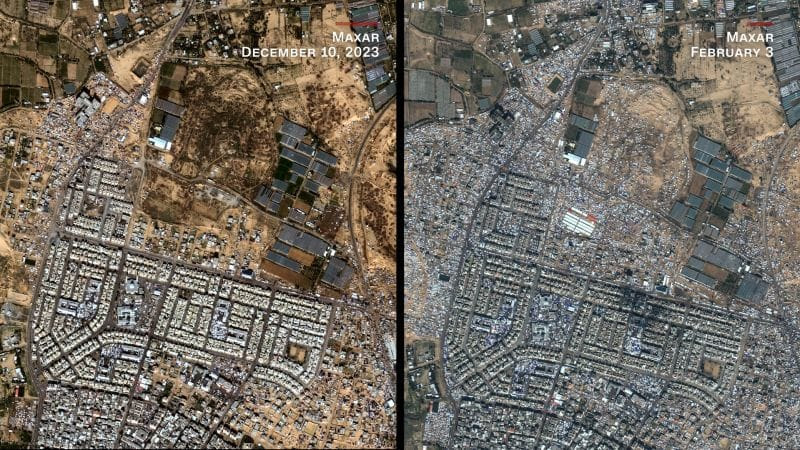
The Israeli Defence Forces (IDF) launched a raid on the Gazan city of Rafah in the early hours of yesterday (Monday) morning, hours after Prime Minister Benjamin Netanyahu claimed there were four Hamas battalions in the city.
The local Red Crescent Society has reported over 100 people killed in the Israeli strikes, which were launched from land, air, and sea.
For its part, Israel says it conducted a “wave of attacks” to provide cover for its special forces, who freed two hostages held by Hamas. IDF Spokesperson Daniel Hagari put it like this: “we have a moral obligation to bring all our hostages home, an obligation that we will continue doing everything in our power to fulfill.”
Stay on top of your world from inside your inbox.
Subscribe for free today and receive way much more insights.
Trusted by 129,000+ subscribers
No spam. No noise. Unsubscribe any time.
But the operation took place in the southern city of Rafah, where 1.4 million Palestinians have taken refuge after several IDF warnings to evacuate the north.
And the prospect of a broader Rafah ground operation has now spread panic in the city, which lies on the border with Egypt (without further evacuation routes).
UN High Commissioner for Human Rights Volker Türk is warning the idea of such a full-scale operation “is terrifying, given the prospect that an extremely high number of civilians, again mostly children and women, will likely be killed and injured.”
And similar sentiments have now been echoed around the world:
- In the US – Israel’s closest ally – the White House reports that President Joe Biden has warned Israeli leader Benjamin Netanyahu not to conduct a military operation against Hamas in Rafah without a “credible and executable” plan to protect civilians
- The EU’s foreign affairs chief Josep Borrell has called on nations, particularly the US, to stop sending arms to Israel
- Egypt is reportedly threatening to suspend its 1978 Camp David peace treaty with Israel if the IDF pushes ahead in Rafah (the Camp David accords have been key to a half century of Israeli-Egyptian peace)
- Australian Foreign Minister Penny Wong says an offensive would have “devastating consequences” for civilians sheltered in Rafah, and
- Saudi Arabia, which had been moving to normalise ties with Israel before October’s Hamas attacks, is stressing the “extremely dangerous repercussions” of a Rafah offensive, while renewing calls for a ceasefire
So what does this mean for the mediation efforts due to resume in Cairo today?A senior Hamas representative has told journalists that “any attack by the occupation army on the city of Rafah would torpedo the exchange negotiations”.
But Netanyahu, determined to defeat Hamas and rescue the hostages, seems convinced the path to that goal now runs through Rafah.
INTRIGUE’S TAKE
What’s the end-game here? It depends on who you ask:
- Hamas wants a ceasefire that preserves its control of the strip
- That’s a non-starter for Netanyahu, who wants the total defeat of Hamas and the release of the ~135 hostages it still holds
- But hostage families want Netanyahu to prioritise negotiating the release of the captives over the military operation against Hamas
- And yet Netanyahu’s hardline coalition partners say they’ll topple his government if he does any “reckless” deal with Hamas
- In parallel, President Biden’s patience is reportedly wearing thin over Netanyahu’s “over the top” response in Gaza, and
- Palestinian civilians are left with a strip in ruins, pushing them “to the brink of starvation”.
US Secretary of State Antony Blinken and others are still engaged in shuttle diplomacy to try and find some kind of common ground in amongst all this. But whatever common ground there is still looks small, shifting, and fraught.
Also worth noting:
- Gaza’s death toll reportedly passed 28,000 this week.
- The two rescued hostages were dual Israeli-Argentine nationals. It’s the second known rescue via Israeli military action since October.
- A Dutch appeals court has halted the sale of F-35 jet parts to Israel, citing a risk of violations of international humanitarian law.