





The US struck various targets across Syria and Iraq on Friday night (local time), in what President Biden described as the beginning of his response to the drone attack that killed three US troops the weekend prior.
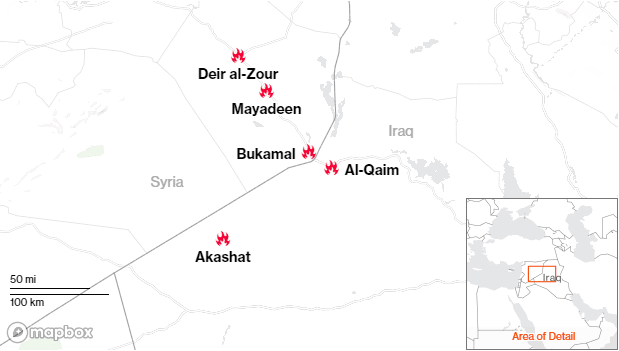
The US strikes reportedly hit 85 targets at seven locations mostly along the Euphrates River – three in Iraq and four in Syria. They lasted around 30 minutes and included B-1 Lancer bombers flying 6,000km from their base in Texas.
Who were the targets?
Stay on top of your world from inside your inbox.
Subscribe for free today and receive way much more insights.
Trusted by 161,000+ subscribers
No spam. No noise. Unsubscribe any time.
They included facilities and positions used by Iran’s Quds Force and affiliated groups. The Quds Force is part of Iran’s Revolutionary Guard (the ideological guardian of Iran’s 1979 revolution), and drives Iran’s proxy strategy abroad.
What were the targets?
The sites reportedly included a range of logistical, storage, command, artillery, radar, and intel facilities.
Why Friday night?
President Biden approved this US response a week ago, and the Pentagon says the specific timing was shaped by local weather conditions.
Still, the apparent delay – plus days of foreshadowing – led to speculation this timing was part of a broader US calculus to hit the groups’ capabilities but slow the broader escalatory cycle.
Will these strikes have any impact?
There are mixed signals here. On the one hand, the specific group most likely responsible for the US casualties (Kataib Hezbollah) surprisingly announced last week it would cease its attacks on US forces in the region.
We say ‘surprising’ because these groups typically hype-up rather than play-down their role, as they compete for influence and resources among themselves.
But then again, this move becomes less surprising when you remember that:
- Iran’s influence over this specific group is pretty clear, with an Iranian officer apparently even sitting on the group’s council
- Iran has reportedly withdrawn its own senior officers from the area to minimise losses, and
- Iran’s Quds commander has reportedly visited Baghdad to push other local proxy groups to tone down their attacks
So this all points to an Iranian effort to step back from the brink, in line with Iranian leaders’ statements that they’re not seeking war.
Still, on Friday, the leader of another group (Al-Nujaba) vowed it will continue to attack US forces until they leave the region and Israel ceases operations in Gaza.
INTRIGUE’S TAKE
Two questions come to mind here.
First, what does this initial US response tell us about US intent?
It looks to us like a US effort to defang rather than dissuade these Iran-backed Shiite groups, which often channel and reflect long-standing local grievances. And the decision to send bombers from Texas looks like a US effort to de-link the US strikes from its own forces in the region, slowing the escalatory cycle.
Second, what about the broader region?
Here’s one way to think about that: hours after the B-1 bombers returned to Texas, another US aircraft touched down in the region with Secretary of State Blinken on board.
Making his fifth trip to the region since the Hamas attacks on Israel, Blinken’s return reflects a US understanding that – while US casualties won’t go unanswered and more strikes are likely – ultimately, a political and diplomatic breakthrough will be key to finding a way out of all this.
Also worth noting:
- Hamas leaders arrived in Cairo on Thursday for talks with Egypt’s spy chief on a possible prisoner exchange and pause with Israel.
- The US and UK also led another round of strikes against 36 Houthi military targets across Yemen over the weekend, after the Houthis continued their attacks on civilian shipping last week.