



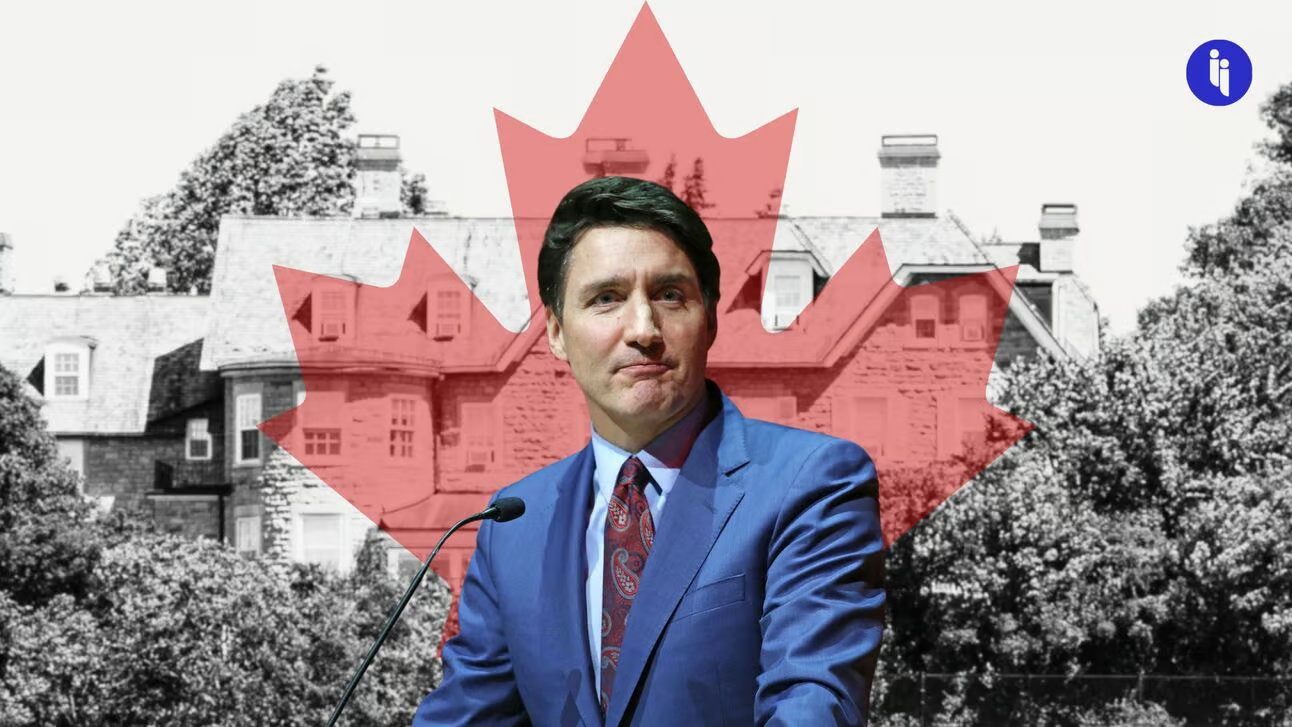
Walking down his front steps at Rideau Cottage yesterday (Monday), Justin Trudeau finally announced he’ll be stepping down as leader of his ruling Liberal Party and therefore as Canada’s prime minister, just as soon as his party chooses a replacement.
We say ‘finally’ because it was inevitable — much of his own party even wanted him out. So now, after a nine-year run and a stint as the world’s longest-sitting G7 leader, Trudeau has bid adieu, closing a political chapter that’s really defined Canada’s image abroad.
What happened?
Stay on top of your world from inside your inbox.
Subscribe for free today and receive way much more insights.
Trusted by 161,000+ subscribers
No spam. No noise. Unsubscribe any time.
By any definition, Trudeau was a certified ‘nepo-baby’ (his dad was a storied PM) who enjoyed a dazzling rise to power in 2015, pole-vaulting his Liberals into government from third place. But after starting out as a progressive hero to millions, the wheels soon started to wobble as the scandals accumulated: ‘ElbowGate’, Aga Khan, that India visit, blackface, WE Charity, Bohemian Rhapsody, you name it.
He returned from a Costa Rica vacation in January 2020 rocking a new beard, which many took as heralding a new Trudeau. But then Covid hit, and the data really started to speak for itself: by then, it already took an average income-earner three decades to save a deposit for a house in many cities, while Canadian incomes lagged well behind the US. For those and many other reasons, 73% of Canadians eventually just wanted him gone.
So what’s next?
Rather than call an election, Trudeau has effectively hit pause on the current parliament until March 24th, giving his Liberals time to choose a new leader for the next elections which are due no later than October this year (likely sooner).
And who’s next? For Trudeau’s liberals, the various names in the mix include:
- Chrystia Freeland, his former deputy PM, foreign and finance minister who spectacularly resigned last month (she hasn’t yet signalled her plans), and
- Mark Carney, Canada’s highly regarded former central bank chief (and the godfather to Freeland’s son), who’s now quietly sounding out his party support.
But no matter who replaces Trudeau as party leader, the polls suggest it’s less a question of whether they then win the general election, and more about how badly they’ll lose to…
- Conservative leaderPierre Poilievre, who’s enjoying a 24 point lead in the polls. That’s partly a rejection of Trudeau, but also partly because of Poilievre himself, merging an aspirational story (adopted out by his teen mother) with promises to unshackle Canada’s freedoms and thereby its economy.
And what does this all mean for the world?
Poilievre is promising to focus on everyday issues impacting Canadians, and that includes the prospect of US tariffs which threaten to disrupt most of Canada’s export base. So he’s promising he can negotiate with Trump to deliver “a great deal that will make both countries safer, richer, and stronger”.
More broadly, Poilievre has also promised more energy exports and more defence spending, paired with less foreign aid and less of what he’s described as Trudeau’s grandiosity. He’s also voiced full-throated support for Israel, and has vowed to withdraw Canada from the China-led Asian Infrastructure Development Bank.
As for India? Poilievre has been notably low-key in response to the extraordinary allegations that Delhi assassinated Canadian citizens on Canadian soil, instead simply pledging to restore ties if he’s PM.
INTRIGUE’S TAKE
Remember 2016? That’s when Trudeau attended his first G7, along with America’s pre-Trump Obama, Germany’s pre-malaise Merkel, and the UK’s pre-Brexit David Cameron, all hosted by Japan’s late Shinzo Abe. And if you must know, Justin Bieber held the top two spots on the US charts, with the rather cross-purposed ‘Love Yourself’ and ‘Sorry’.
Anyway, even after France’s 39-year-old Macron then yoinked the title as the G7’s youngest leader, Trudeau remained a summit superstar for a while. We saw it in person as he stopped with a smile when exuberant foreign officials asked for a selfie.
But we’ve since seen that summit stardom fade, partly due to sheer familiarity, but also partly as Trudeau’s approach grated more on capitals abroad: whether it was trade partners watching him almost tank the revived TPP trade pact; or allies watching him go slow on NATO commitments; or even his fans watching him send mixed messages by approving a major oil pipeline the day after declaring a national climate emergency.
Anyway, the world has changed radically since 2016, and Trudeau’s exit really feels to us like the end of an era that goes well beyond his own beautiful, snowy capital.
Also worth noting:
- Canadian Foreign Minister Mélanie Joly is also being floated as a possible Liberal Party replacement.
- Trump has named former US ambassador to the Netherlands, Pete Hoekstra, as his next envoy to Canada.
- Canada is due to host the G7 in June.