




It’s been one of those weekends that’s again left the world wondering if we’re about to see a full-scale regional conflict in the Middle East.
So here’s what you need to know.
Israel and Hezbollah have had daily skirmishes since October 8th, when Hezbollah fired off rockets in solidarity with the Hamas attacks a day earlier.
Stay on top of your world from inside your inbox.
Subscribe for free today and receive way much more insights.
Trusted by 161,000+ subscribers
No spam. No noise. Unsubscribe any time.
And for its part, Israel has now assassinated two dozen Hezbollah commanders, leaving us and others wondering how much Israeli intelligence has penetrated the security-conscious group (beyond the standard electronic eavesdropping).
But despite the occasional flare up, Israel and Hezbollah have mostly adhered to carefully calibrated red lines to avoid escalating beyond the constant state of conflict that now passes for normal.
And that all seemed to continue as we entered the weekend, with an Israeli airstrike killing four Hezbollah members on Friday, and Hezbollah announcing a dozen rockets back against an Israeli military site the next day.
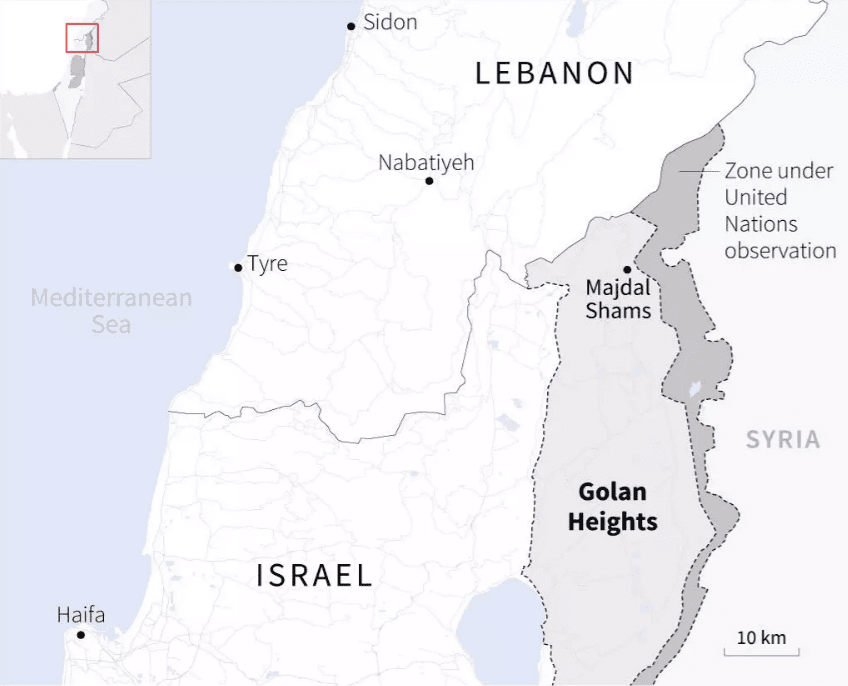
But… a rocket then hit a soccer field in the Golan Heights, killing a dozen teens and children among a local Druze community.
(Btw, here’s a quick glossary:
- The Druze people are an Arabic-speaking ethnoreligious minority located mostly across Syria, Lebanon and Israel
- The Golan Heights used to be Syria’s, until Israel seized most of the area after a surprise Arab state attack against Israel in 1967, and
- Hezbollah is the Iran-backed Shiite Islamist group controlling much of southern Lebanon, and listed as a terrorist organisation by ~60 countries)
So what now?
Despite announcing the rocket attacks, Hezbollah is now denying it was involved in the one that hit the soccer field. Ditto its backers in Iran, with the foreign ministry there claiming “the apartheid Israeli regime is trying to distract public opinion and global attention from its wide-ranging crimes in Palestine“.
But while US intelligence is reportedly unsure about Hezbollah’s intended target, it has “no doubt” Hezbollah fired the rocket that has now caused the largest loss of life on the Israeli side since October 7th.
So Prime Minister Netanyahu has cut short his US trip to return home, telling an Israeli Druze leader that Hezbollah will pay an unprecedentedly “heavy price“.
As for the rest of the world? It’s mostly urging restraint, while quietly preparing for the opposite (by urging foreign citizens to leave the area).
So what’ll Israel do? For now, it’s conducted airstrikes against Hezbollah targets across southern Lebanon, within the scope of the ongoing tit-for-tat.
But some members of Netanyahu’s coalition government want him to go harder.
INTRIGUE’S TAKE
There are still reasons to believe nobody wants a wider war here:
- Hezbollah knows the Lebanese people (including a quarter million Druze folks) are already in a world of political-economic pain, while
- Israel has been wary of Hezbollah ever since their bloody ‘draw’ in 2006, with the group now boasting ~100,000 armed members.
But, yet again, it’s also possible this is becoming something more:
- This attack will bolster those arguing Israel’s north can’t be secure until Hezbollah is pushed back
- A majority of Israelis already want to move against Hezbollah, and
- Netanyahu’s decision-making will also be shaped by his own political and legal woes.
So where to from here? One possible clue is that Israeli officials are quietly telling their neighbours, including via back-briefings to Sky News Arabia, that while Israel will respond forcefully, “we don’t intend to spark a war.”
The other possible clue is around what the players actually do, and right now, Hezbollah is quietly clearing out its key military sites along Lebanon’s border with Israel, anticipating that this is still where Israel will focus its response.
Also worth noting:
- A 2006 UN Security Council resolution called for Hezbollah to pull its forces back behind the Litani river, some 20km from Israel’s border. Hezbollah hasn’t done so.
- Phil Gordon, the national security advisor to Vice President Kamala Harris, says the Democratic Party’s presumptive 2024 nominee condemns “Hezbollah’s horrific attack” and that “the vice-president’s support for Israel’s security is ironclad.” For his part, Donald Trump says the attack was “almost the entire fault of the incompetent Biden-Harris Administration”.
- Officials from Israel, Egypt, Qatar and the US met in Rome yesterday (Sunday) to continue negotiations over a ceasefire and hostage release deal in Gaza. The talks remain stalled over various key details.