





🌍 Why we’re going to the Moon (again)
Plus: Try Putin’s favourite app (or else)
|
Today’s briefing: |
|
Good morning Intriguer. True story: my first visit to SpaceX, after signing the kind of NDA that’d make Bond blush, I watched as a mullet-clad male in jorts aggressively angle-grinded what looked like alien spaceship parts, sparks flying while Springsteen blasted beneath an American flag so big it seemed personally offended by gravity.
Hours later, I was at a major defence contractor observing as two clean-cut nerds in pristine white lab coats solemnly examined a single widget, clipboards in hand.
Then I closed the day out at NASA’s famous Jet Propulsion Laboratory, getting a perfectly polite PowerPoint presentation in a windowless conference room. With sandwiches.
All that to say these were three very different cultures, working to three very different rhythms, and yet somehow all supposed to work together to get us back to the Moon.
That’s today’s briefing, just hours before NASA’s latest Moon mission is due for lift-off.

PS — Tomorrow (Thurs) will be the week’s final briefing, but we’ll be back Tuesday!
Intrigue Insight – Iran war: Day 33?
On the battlefield:
-
President Trump’s latest line is he foresees wrapping up the war within “maybe two weeks, maybe three”, while President Pezeshkian now argues Iran has “the necessary will to end this war”, subject to certain conditions. Comment: Take it all with a quarry of salt — Pezeshkian is a powerless figurehead, Trump has dropped similar hints since week one, and they’re both still basically saying they’ll end the war just as soon as they get everything they want. Still, oil has dropped back below $100/ barrel, which maybe reflects optimism, but can also merely reflect trader assessments that *others* are feeling optimistic. Should we pass the salt?
-
Meanwhile, The Wall Street Journal reports the Emiratis are prepared to join the US in forcibly reopening the Strait of Hormuz. Comment: It’s hard to see how any Gulf state can realistically accept the status quo, of Iran’s wounded, apocalyptic regime exercising a virtual tollbooth on the entire world’s access to Hormuz.
Other:
-
Following a pattern we explored on Monday, Indonesia has introduced daily fuel rations, while Australia’s Albanese has addressed the nation to a) halve fuel taxes, b) urge citizens to conserve but not stockpile fuel, and c) brace for some tough months ahead. The UK’s Starmer has also addressed his nation, declaring it’s not the UK’s war, offering more help for households, and proposing a summit on re-opening Hormuz. Trump and India’s Modi are also scheduled to address their nations later today (Wed).
Shoot for the Moon.
If everything goes to plan (pretty big ‘if’ these days), NASA’s Artemis II mission will take off from Florida’s Kennedy Space Centre aboard a 98m (322ft) rocket during a two-hour window later today (Wednesday), from 18:24 ET.
Destination? The Moon.
It’s a fly-by rather than landing, but still significant for a couple of reasons:
-
Slingshotting around the Moon, the astronauts will end up 400,000km (250,000mi) from Earth, the farthest humans have ever ventured, and
-
One of those four astronauts (Canada’s Jeremy Hansen) will be the first non-US citizen to leave Earth’s orbit.
But the mission is really part of a dress-rehearsal for Artemis IV (maybe 2028?), which aims to put folks back on the Moon for the first time since 1972. And that’s all a stepping stone to Mars, though NASA hasn’t gotten around to coining a cool Greek program name yet.
So… where’s the intrigue?
Recall that last century’s Apollo program (all 11 of them) aimed to a) beat the Soviets, b) demonstrate US technological and industrial supremacy, and thereby c) signal the broader superiority of the US political and economic system (free market democracy).
We mention all this because in Greek mythology, Apollo had a twin sister called… Artemis. And as today’s sister program, Artemis shares Apollo’s aims beyond walking the Moon: she’s likewise chasing an aura boost (Gen Z, did we use that correctly?) in a tense world.
But there are a few key differences. First, this is less about a flags-and-footprints repeat of Apollo, and more about establishing a sustainable, long-term lunar presence — or to put it another way, it’s about who sets the rules for the next century of space exploration.
Second, Artemis has a bigger economic component via its vision for a lunar economy, extracting lunar resources, and leveraging more US businesses along the way. Or to put it another way, it’s about who gets the benefits from space and its exploration.
But also third, the competition now looks different.
Today’s primary rival is China, targeting its first crewed lunar landing by 2030, followed by a permanent south-pole base for resource extraction.
The Russians are still there too, though looking wobbly after their big 2023 lander crash, plus last November’s accident at their only crewed launch pad (repairs are ongoing).
The two neighbours also work together on the International Lunar Research Station, the planned nuclear-powered rival to Artemis, nominally scheduled for 2035.
But their aims in space? Similar to America’s, though with some key additions:
-
Moscow and Beijing are signalling to a hedging world that you can skip the chaos and decadence of Western democracy, and still deliver high-tech triumphs
-
They’re also signalling to their own citizens back home that maybe one-party, strongman rule offers the best path to national greatness, and
-
For Putin specifically, a space program (like a nuclear program) also helps him cosplay as a world player amid his failing invasion of a much smaller neighbour.
Meanwhile, of course, there are others now gunning for space, too, whether India and Japan (who’ve already achieved an uncrewed lunar landing), or the EU (aiming to join that club in 2030).
And sure, all three cooperate with the US — including via Artemis — but if you read their strategies, they’re all really chasing space autonomy more than leadership: ie, in a multipolar world, they’re prioritising space access without overreliance.
All this to say that in today’s world, that Moon above now feels much less like a finish line.
Intrigue’s Take
We’ve naturally focused on this mission’s international dimensions, but there’s also an internal angle to Artemis with big implications: with American trust in public institutions sitting near record lows, today’s launch theoretically presents a chance to remind folks that governments can (and must) still achieve extraordinary things.
But we use ‘theoretically’ advisedly — for many (including NASA’s new boss, Isaacman), today’s $4B per-launch SLS rocket (Boeing) and $20B Orion capsule (Lockheed) will be proof of NASA’s bloated cost-plus contracts, not to mention the agency’s struggles with bureaucracy, risk-aversion, and even politicisation (to spread the spend across 50 states).
The other related internal angle is around America’s evolving public-private equilibrium, as Isaacman aims to lean more into US private sector strengths. Players like Musk’s SpaceX and Bezos’s Blue Origin each bring their own cultures, speeds, and egos, though that’s actually not as new as it sounds: some of America’s earliest space advances, whether liquid-fuel rocketry or the Lick and Wilson observatories, were actually bankrolled by America’s richest families at the time, like the Guggenheims and Carnegies.
So while this broader Space Race 2.0 plays out, history might also see today’s Artemis launch as a broader stress test for whether 21st-century America can still nail that messy blend of public ambition and private dynamism, and thus still do big, hard things together.
Sound even smarter:
-
Artemis I sent an uncrewed flight around the Moon in 2022; Artemis II is today’s crewed fly-by; and Artemis III (maybe 2027?) aims for crewed testing with SpaceX and/or Blue Origin landers. Artemis IV (maybe 2028?) aims to then walk on the Moon. The original goal was for Artemis III to already walk on the Moon by 2024.
-
Via Artemis, Japan has committed to develop (with Toyota) a pressurised lunar rover, in return for the US committing to fly two Japanese astronauts on future Artemis landings. They’d be the first non-American(s) to walk on the Moon.
Today’s briefing is presented by…
The Free Newsletter That Tech Geniuses Love

Looking for a free tech newsletter trusted by the industry’s biggest names? Subscribe to The Current, a free daily tech newsletter written by Kim Komando to help you understand AI, keep up with tech news, and learn useful tips in just 5 minutes a day.
 |
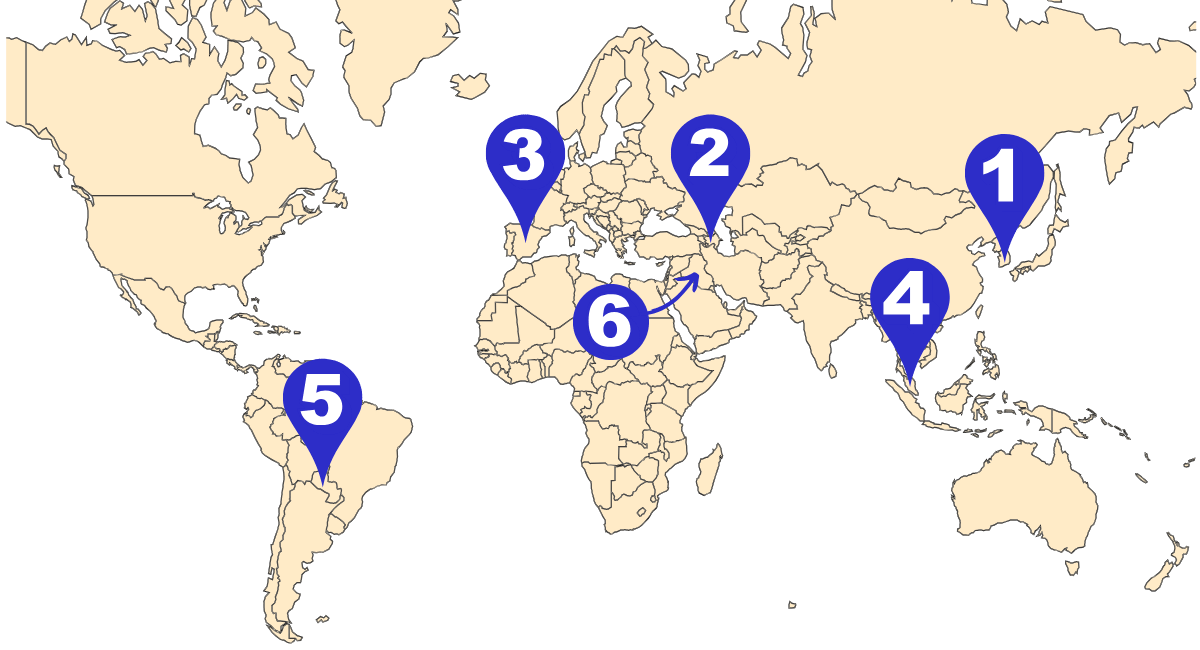
🇰🇷 SOUTH KOREA — Record exports. Comment: South Korea has among the world’s most Hormuz-dependant economies, including for both oil (~70%) and key chip inputs like helium (65%). Maybe it’s a sign this AI supercycle is more powerful than the latest geopolitical shock (Iran), though that vulnerability will just get more painful each week this war drags on. |
 |
🇦🇿 AZERBAIJAN — Bypassing chokeholds. Comment: Turkey is rushing its TRIPP segment because this project offers a direct link to oil-rich Azerbaijan, without having to rely on Russia or Iran. The most sensitive central part of TRIPP (43km via Armenia) is due to start construction later this year. |
 |
🇪🇸 SPAIN — High as a kite. |
 |
🇲🇾 MALAYSIA — Not above the law. Comment: ‘Billion Dollar Whale’ is the definitive telling of the remarkable 1MDB story, and it’s worth your time. While some (including a Goldman banker) have gone to jail, the main ringleader (Jho Low) is hiding in China amid an Interpol red notice. |
 |
🇵🇾 PARAGUAY — Heads to roll. |
 |
🇮🇶 IRAQ — Abducted in broad daylight. Comment: Iraq’s interior ministry isn’t naming names, though one obvious suspect is a pro-Iranian militia like Kataib Hezbollah, which previously kidnapped Russian-Israeli researcher Elizabeth Tsurkov. Iran-sympathetic Baghdad often turns a blind eye to the group’s actions, making DC’s next move all the more critical. |
Extra Intrigue
The Intrigue jobs board 💼
-
Director of International Relations @ City of Los Angeles in California
-
Senior Advisor, Human Rights Compliance @ Dell Technologies in Dublin
-
Coordinator, Programs @ International Red Cross in Honduras
-
Protocol Officer @ British Embassy in Washington, D.C.
App of the day

Meet Russia’s new ‘favourite’ app: Max.
Those sassy airquotes are because, as is so often the case in Putin’s Russia, folks don’t get a lot of say in the matter. After years of Muscovites juggling VPNs to evade the censors and keep using Western apps like WhatsApp, Putin started pushing Max as a homegrown alternative.
Except nobody wanted to download it, so the Kremlin is now “strongly advising” everyone from universities and apartment blocks to sports teams and corporations to switch to Max.
New phones now even come with it pre-installed, and refusing is only getting harder. From May, if you use more than 15GB of international data in a month, you’ll now get hit with extra charges. Because nothing says “winning the information war” like forcing your citizens onto a government-controlled app, then charging them fees for trying to leave.
Today’s poll
Do you think space exploration is worth its hefty price tag? |
Yesterday’s poll: Why do you think Trump let the Russian tanker through to Cuba?
⛑️ A humanitarian gesture (6%)
🤷 Because it's not a big deal (8%)
🚢 He TACO'd (40%)
💬 Part of US-Cuba talks (41%)
✍️ Other (write us!) (5%)
Your two cents:
-
💬 J.W: “America still controls the situation and a little sign of good faith can go a lot farther with a country's oppressed population than another foot on their neck.”
-
⛑️ J.H: “Creating a humanitarian crisis in Cuba was creating bad optics and would complicate progress in talks with Cuba.”