


🌍 Will the strategic oil reserves save us?
Plus: Meme of the day

|
Today’s briefing: |
Sponsored by:  |
Good morning Intriguer. With the Iran conflict not looking to abate anytime soon, and the International Energy Agency announcing its biggest strategic oil reserve release in history, it’s time to explore what exactly these reserves are, how they work, and how they impact the markets. All that and more in today’s briefing. Let’s dive in.

Intrigue Insight: Iran war, day 13
Here’s a quick recap of what’s happened since our last briefing.
In the markets:
-
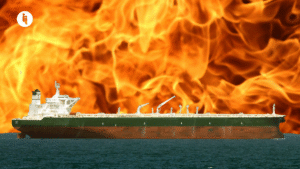
Oil has pushed back above $100 after Iranian strikes hit six more vessels (one US-owned) in or near the Strait of Hormuz, bringing the total to 16. Two of the tankers are now ablaze in Iraqi waters after being hit by explosive-laden boats.
-
In just two weeks of this war, Putin might’ve now earned an extra $6.9B in oil revenues.
-
Several banks, including Citibank and HSBC, have temporarily closed their branches in Qatar and the UAE amid Iranian threats against US and Israeli financial institutions in the region.
On the battlefield:
-
Iran has landed hits across Iraq, Bahrain, Kuwait, and the UAE, with reports of an Iranian strike on an Italian military base in Iraqi Kurdistan. Iran has also claimed (sans proof) hits on two Israeli military bases and the Shin Bet headquarters.
-
For its part, Israel has now announced escalating attacks after landing multiple drone strikes on regime checkpoints — it’s trying to weaken the regime’s grip on power, though US intelligence suggests the regime isn’t budging (the regime itself says the new supreme leader was wounded in the hit that killed his father).
-
Meanwhile, Israel and Hezbollah have exchanged heavy fire amid reports the group is bracing for another full-scale Israeli ground offensive in Lebanon’s south.
Drop in the ocean
A stray acquaintance recently cornered us with oil market questions because they’re now gambling investing their life savings in the sector, so here’s what we told them:
What’s this about tapping our strategic petroleum reserve (SPR)?
With Iran squeezing the Strait of Hormuz (aka 20% of global oil exports), prices are soaring and governments are panicking, so the 32 countries in the Paris-based International Energy Agency (IEA) have agreed to release 400 million barrels of oil from their strategic reserves — it’s the biggest injection in the organisation’s history.
Strategic oil reserves, you say?
The IEA itself was a product of the 1973 oil crisis, when Middle Eastern oil exporters refused to supply anyone that backed Israel during the Yom Kippur War (aka the surprise Egypt/Syria-led attack on Israel to reclaim territories they lost in 1967).
A core IEA membership requirement has long been to hold strategic oil reserves: emergency supplies equivalent to at least 90 days of net oil imports. It can take different forms, whether refineries, terminals, or just huge tanks in random places. Two fun facts:
-
The US reserves are in salt caverns along the Texas and Louisiana coasts, and
-
New Zealand stores some of its reserves in Italy! That sounds impractical, but the point is often not to use the reserves yourself, but to meet your collective duty, and it’s cheaper for NZ to do that via Italy than build tanks at home.
Anyway, IEA members theoretically coordinate the timing and size of any release to smooth out oil shocks and help stabilise their economies and societies.
How much oil are we talking?
IEA members now store ~1.2 billion barrels, with another 600 million barrels of private oil held under government obligation.
So this historic 400 million barrel release sounds big until you consider the but: we mostly don’t know exactly when, or at what rate — it’s like getting told your salary will be $1,000. Per year? Illegal. Per hour? Sign us up.
We do, however, know the two biggest moves:
-
The US is releasing 172M barrels over 120 days. That’s almost half its reserve, so a big deal in one sense, but at 1.4 million barrels per day (realistically slower), we’re talking not even 10% of the Hormuz hit, and maybe 1% of global daily consumption. Yet releasing directly into the US, it’ll more than cover the direct US exposure to Hormuz (~0.5M barrels), which is presumably the aim. Meanwhile…
-
Japan is releasing 80M barrels (17% of its total) to begin as early as this Monday, though Tokyo hasn’t clarified its daily rate. The country is highly Hormuz-dependent, and will realistically prioritise rapid relief for its own key refineries.
What about China?
It’s not a full IEA member, though has been secretly amassing its own vast reserves for years, and is seemingly the one buyer still getting Hormuz oil thanks to its regime friends.
And sure, world oil markets clearly benefit from the second-largest economy not running out of oil, but China’s broader record is mixed: after Putin invaded Ukraine, China agreed to join the US in tapping its own reserves — but not only did that not happen, China actually ended up boosting its own reserves, and even bought a million barrels from the US release! The US ended up banning SPR sales to China as a result.
So will all this lower oil prices?
Any extra oil inevitably helps with market tightness, but keep three more things in mind.
First, there are logistical constraints — in addition to America’s traditional daily SPR ceiling, it takes 13 days for that US crude to actually hit the markets.
Second, markets are people, and people are emotional — if your Caribbean cruise gets a little rocky and the crew starts readying the life rafts, are you… relieved? What about when the crew reveals they’re resorting to the biggest life rafts in history…?
And third, will Hormuz be back to full flow by the time that 120-day US release finishes? Or does the US have to start replenishing its reserves at $100+ per barrel?
Maybe that’s all why the day of the IEA announcement, oil prices actually closed up 5%.
Intrigue’s Take
Perhaps oil shrugging off the biggest IEA release in history tells you everything you now need to know: no matter the size of this release, it doesn’t address the actual problem.
The actual problem? The Strait of Hormuz now seems closed to everything but Iranian ships to China. We already doubted the idea of this all somehow being the US playing 4D chess against China, but it’s starting to look more like playing Hungry Hippos.
And if we stay focused on the actual problem (Hormuz), it’s not just far from a solution, but getting farther, with Iran answering the big IEA release with suicide boat attacks on tankers! It’s signalling determination to strangle oil markets until Trump relents.
As for any US naval escorts — you think the US is now going to risk a $2B destroyer defending each $200M-load of oil that’s not even US bound? C’mon. Meanwhile, as motorists around the world start feeling the oil pinch, you think they’ll all blame Iran?
Anyway, with another Omani oil facility now ablaze, this might all be beyond TACO (Trump always chickens out). We need a new Mexican-food-linked acronym for the fact that even if the president hits pause, the pain will continue. Something like… nasty aftereffects coming, hold on (aka NACHO).
Sound even smarter:
-
DC recently renewed its threat to leave the IEA over the body’s climate policy.
-
As a net exporter, the US is technically not required to keep a strategic reserve.
Today’s newsletter is sponsored by Grey Dynamics
Every major intelligence recruitment follows the same five-phase structure. Build rapport. Establish context. Align your offer with what the other person actually wants. Address their concerns before they raise them. Close with clarity.
This is the Pitch Framework. It is the same methodology CIA officers use to develop human sources, now taught to professionals in policy, finance, and corporate strategy.
Grey Dynamics’ HUMINT Fundamentals course is taught by Ray White, a retired CIA senior operations officer with 25+ years running the Agency’s largest training programme. You will learn why preparation is the pitch, why motivations drive everything, and why the best proposals never feel like proposals at all. Download The Pitch Framework and see for yourself.
Meanwhile, elsewhere…
 |
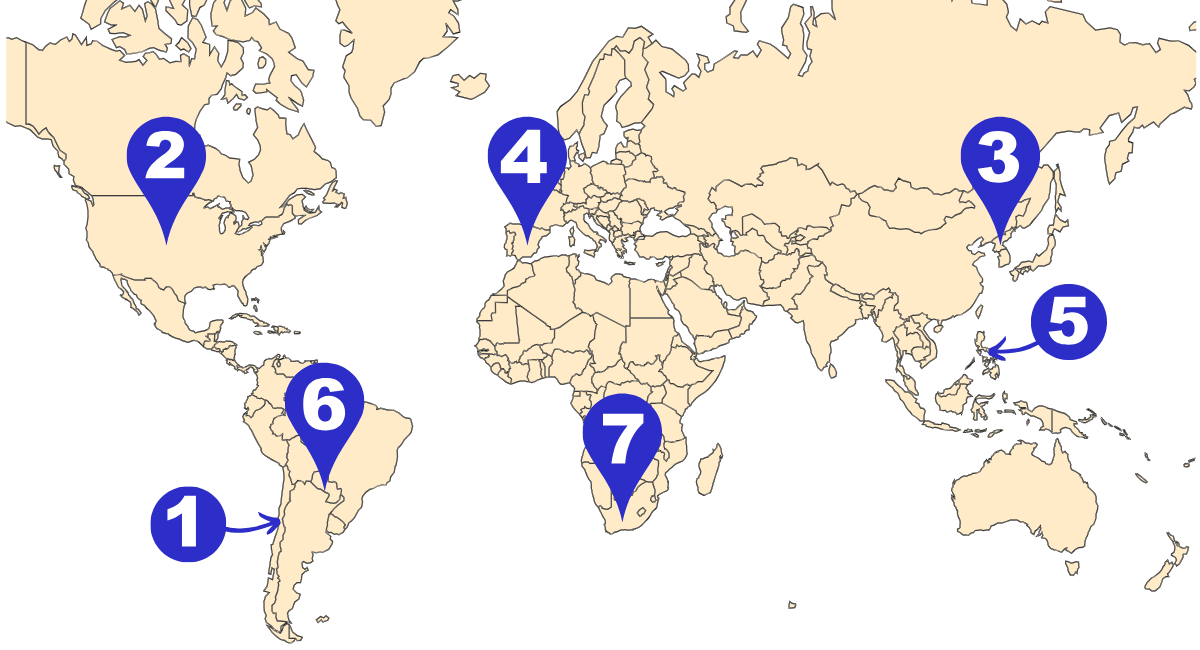
🇨🇱 CHILE — New President. Comment: The pro-business Kast has pledged to roll back his left-leaning predecessor’s state intervention in Chile’s lithium sector, though the details will depend on negotiations with the legislature, where his allies are still a minority. |
 |
🇺🇸 UNITED STATES — Lemme probe ya. Comment: The probes into unfair trading practices are really about building a case to re-impose tariffs after last month’s Supreme Court decision, and the timing is rough: the targets include partners in Asia (like Indonesia, Thailand, Korea, Vietnam, Taiwan, and Bangladesh) already grappling with the oil fallout from Iran. |
 |
🇰🇵 NORTH KOREA — All aboard! Comment: The fact North Korea already resumed direct train links with Russia last year suggests the paranoid state sees better risk-reward payoff (tech-military) with Russia, though it still knows its economic lifeline (98% of official trade) is China. |
 |
🇪🇸 SPAIN — Severed ties. Comment: Israel-Spain ties have been toxic for a while (the Israelis haven’t had an ambassador in Spain since early 2024). So why the sudden downgrade? The decree doesn’t specify, but it’s probably linked to Spain’s opposition to the Israeli-US hits on Iran. |
 |
🇵🇭 PHILIPPINES — Sorry, cousin. Comment: The 1987 constitution explicitly calls for a ban on dynasties, but powerful families still dominate — by some estimates, they control 80% of the seats! The sudden interest in actually legislating the ban comes after a string of scandals, pushing even President Marcos himself (from the ultimate dynasty) to demand action. |
 |
🇵🇾 PARAGUAY — Come on in. Comment: The stated focus is organised crime amid Trump’s new security-led cartel strategy — landlocked Paraguay is near key trafficking routes. But the unspoken bonus is countering China’s recent military diplomacy gains across the region. |
 |
🇿🇦 SOUTH AFRICA — Too far? |
Extra Intrigue
Some of the things we’ve marked in our calendars
-
🇺🇸 The US treasury secretary (Bessent) and his 🇨🇳 Chinese counterpart (He) meet in Paris this weekend ahead of the Xi-Trump summit in Beijing from 31 March.
-
Film buffs will tune in for the 📽️ 98th Oscars this Sunday, with the best pic a race between Ryan Coogler’s Sinners and PT Anderson’s One Battle After Another.
-
And 🇵🇪 Peruvians go to the polls on April 12th to pick from a record 36 presidential candidates in the first round, the same day 🇭🇺 Hungarians seem set to end 16 years of the Putin-friendly Orbán government.
Meme of the day
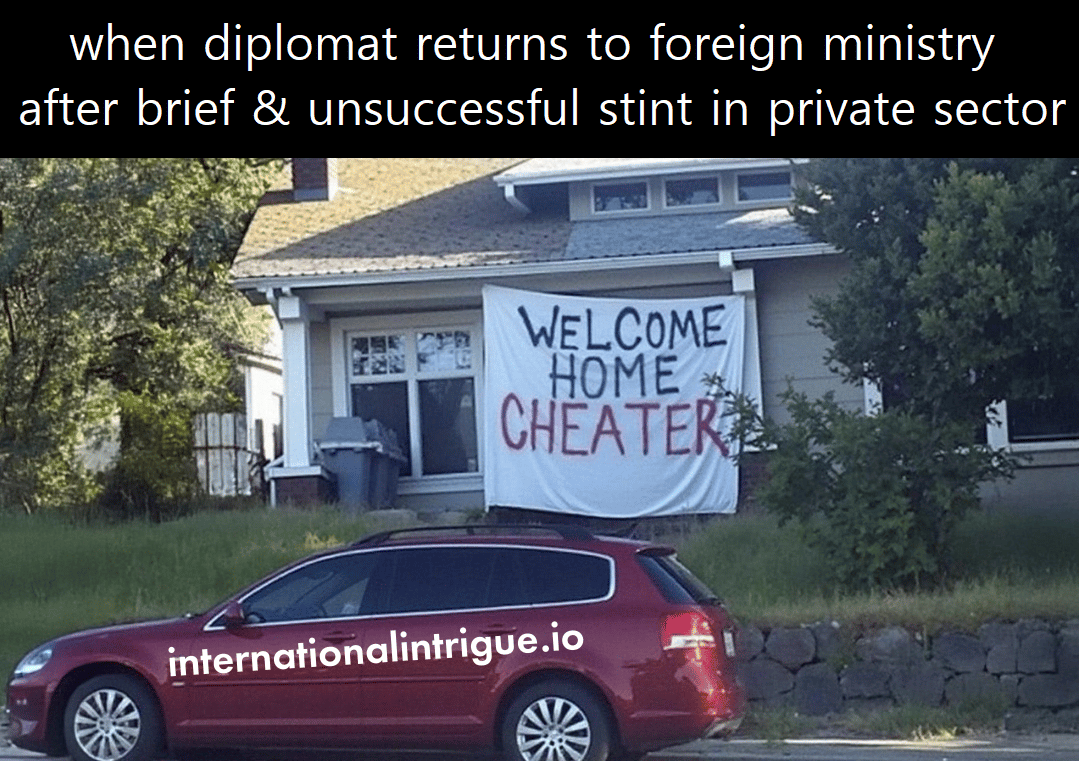
Via our resident meme-lord, @DickerPicss
In retrospect, joining the foreign service is a liiiiitle like joining a cult:
-
You give up control over your life (“no you cannot return home for that funeral”)
-
You pledge allegiance to the hierarchy (“ambassador’s orders”), and
-
You practice insider language and rituals (“she got put on DCL after a TDY at UNGA where her DCM forgot to clear a TPN through EAD before NPT”).
Likewise, the experience of leaving the foreign service is a tad cultish too: colleagues wish you well, but their eyes? They cry betrayal! Still, things are improving as foreign ministries gradually see the value of rotating diplomats through industry and elsewhere.
Today’s poll
Beyond ending the war, what else do you think could quickly stabilise oil markets? |
Yesterday’s poll: Which sector do you think will be hit hardest by the Iran war?
🌾 Agriculture (22%)
✈️ Aviation (21%)
🛢️ Petrochemicals (53%)
💽 Electronics (2%)
✍️ Other (write in!) (2%)
Your two cents:
-
🛢️ D.H: “Petrochemicals, particularly in Europe. I have been working with some of the bigger players and they have already struggled before this war — it is looking much worse now. ”
-
🌾 S.P: “Harvest comes but once a year. Any price fluctuation in fertilizer now will be baked in for a while.”
-
✈️ D.D: “Jet fuel is the most sensitive of the refinery products to supply shocks; there isn't much of a buffer, and airlines stopped hedging a while back.”